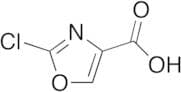
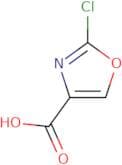
CAS 706789-07-3
:2-Chlorooxazole-4-carboxylic acid
Description:
2-Chlorooxazole-4-carboxylic acid is a heterocyclic organic compound characterized by the presence of both a chloro substituent and a carboxylic acid functional group on an oxazole ring. The oxazole ring consists of a five-membered aromatic structure containing both nitrogen and oxygen atoms, which contributes to its unique chemical properties. The presence of the chlorine atom typically enhances the compound's reactivity, making it useful in various synthetic applications. The carboxylic acid group imparts acidic characteristics, allowing for potential interactions in biological systems or as a precursor in chemical synthesis. This compound may exhibit biological activity, making it of interest in pharmaceutical research. Its solubility and stability can vary depending on the solvent and conditions, which is crucial for its application in different chemical reactions. Overall, 2-Chlorooxazole-4-carboxylic acid is a versatile compound with potential uses in medicinal chemistry and organic synthesis, owing to its functional groups and structural features.
Formula:C4H2ClNO3
InChI:InChI=1/C4H2ClNO3/c5-4-6-2(1-9-4)3(7)8/h1H,(H,7,8)
SMILES:c1c(C(=O)O)nc(Cl)o1
Sort by
Purity (%)
0
100
|
0
|
50
|
90
|
95
|
100
Found 5 products.
2-Chlorooxazole-4-carboxylic acid
CAS:Formula:C4H2ClNO3Purity:95%Color and Shape:SolidMolecular weight:147.51662-Chlorooxazole-4-carboxylic acid
CAS:2-Chlorooxazole-4-carboxylic acidPurity:95%Molecular weight:147.52g/mol2-Chlorooxazole-4-carboxylic acid
CAS:Formula:C4H2ClNO3Purity:95%Color and Shape:SolidMolecular weight:147.512-Chlorooxazole-4-carboxylic Acid
CAS:Controlled ProductFormula:C4H2ClNO3Color and Shape:NeatMolecular weight:147.5172-Chlorooxazole-4-carboxylicacid
CAS:2-Chlorooxazole-4-carboxylic acid is a synthetic compound belonging to the group of long-chain aliphatic carboxylic acids. It is an ester that can be synthesized by the reaction of toluene with 2,4-dichlorooxazole. The stereochemical configuration of this molecule is unknown. The synthesis of this compound has been reported in marine invertebrates and plants, including Mycalolide from the marine sponge Mycale sp.Formula:C4H2ClNO3Purity:Min. 95%Molecular weight:147.52 g/mol