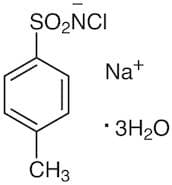
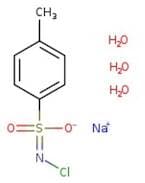
CAS 7080-50-4
:Chloramine-T trihydrate
Description:
Chloramine-T trihydrate, with the CAS number 7080-50-4, is a chemical compound that serves primarily as a disinfectant and antiseptic. It is a white crystalline solid that is soluble in water, forming a solution that is often used in various applications, including laboratory settings and medical disinfection. The compound is a derivative of chloramine and is known for its stability and effectiveness against a broad spectrum of microorganisms, including bacteria and fungi. Chloramine-T trihydrate releases active chlorine when dissolved, which contributes to its antimicrobial properties. It is also utilized in organic synthesis as a reagent for the chlorination of various substrates. Safety precautions are necessary when handling this compound, as it can be irritating to the skin and eyes, and proper storage conditions should be maintained to prevent degradation. Overall, Chloramine-T trihydrate is valued for its utility in both industrial and healthcare environments due to its potent disinfecting capabilities.
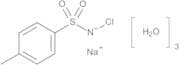
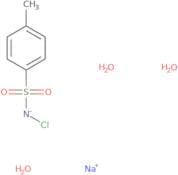
Formula:C7H8ClNO2S·3H2O·Na
InChI:InChI=1S/C7H8ClNO2S.Na.3H2O/c1-6-2-4-7(5-3-6)12(10,11)9-8;;;;/h2-5,9H,1H3;;3*1H2
InChI key:InChIKey=XIFMVZLWZNEDNS-UHFFFAOYSA-N
SMILES:S(NCl)(=O)(=O)C1=CC=C(C)C=C1.[Na].O
Synonyms:- Benzenesulfonamide, N-chloro-4-methyl-, sodium salt, trihydrate
- Chloramine T sodium salt
- Chloramine-T trihydrate
- N-Chloro-p-toluenesulfonamide sodium salt trihydrate
- N-Chloro-p-toluenesulfonamide, sodium salt
- N-Chloro-p-toluenesulphonamide sodium salt trihydrate
- Sodium Chloro[(4-Methylphenyl)Sulfonyl]Azanide Hydrate (1:1:3)
- Sodium, (N-chloro-p-toluenesulfonamido)-, trihydrate
- Tosylchloramide sodium trihydrate
- benzenesulfonamide, N-chloro-4-methyl-, sodium salt, hydrate (1:1:3)
Sort by
Purity (%)
0
100
|
0
|
50
|
90
|
95
|
100
Found 11 products.
Chloramine T Trihydrate
CAS:Formula:C7H7ClNNaO2S·3H2OPurity:>98.0%(T)Color and Shape:White to Light yellow powder to crystalMolecular weight:281.69Chloramine-T trihydrate, 98%
CAS:Chloramine-T trihydrate is used as an intermediate in the manufacture of chemical substances such as pharmaceuticals. It combines with iodogen or lactoperoxidase and is commonly used for labeling peptides and proteins with radioiodine isotopes. Hypochlorite released from chloramine-T acts as an effeFormula:C7H13ClNNaO5SPurity:98%Color and Shape:Crystals or powder or crystalline powder, WhiteMolecular weight:281.68Chloramine-T trihydrate, ACS, 98.0-103.0%
CAS:Reagent for selective oxidation of methionineFormula:C7H13ClNNaO5SPurity:98.0-103.0%Molecular weight:281.68Chloramine T trihydrate
CAS:Formula:C7H7ClNNaO2S·3H2OPurity:98.0 - 103.0 % (C7H7ClNNaO2S · 3H2O)Color and Shape:White crystalline powderMolecular weight:281.69Chloramine-T trihydrate
CAS:Chloramine-T trihydrateFormula:C7H7ClNO2S·Na·3H2OPurity:98%Color and Shape: white crystalline powderMolecular weight:281.68959g/molTosylchloramide sodium trihydrate
CAS:Tosylchloramide sodium trihydrate is an agent of disinfectant. It is also used as a biocide in air fresheners and deodorants.Formula:C7H10ClNNaO3SPurity:98%Color and Shape:White To Off-White Crystalline PowderMolecular weight:246.66Chloramine-T Trihydrate
CAS:Controlled ProductApplications Chloramine-T Trihydrate is used as a safe and convenient electrocyclisation (oxidizing) agent in the preparation of 8-chloro-[1,2,4]triazolo[4,3-a]pyrazine derivatives.
Not a dangerous good if item is equal to or less than 1g/ml and there is less than 100g/ml in the package
References Mal, S., et al.: Tetrahedron Lett., 56, 2896-2901 (2015)Formula:C7H7ClNO2S·3Na·3H2OColor and Shape:Off-WhiteMolecular weight:736.98Chloramine T trihydrate
CAS:Formula:C7H13ClNNaO5SPurity:96%Color and Shape:SolidMolecular weight:281.68Chloramine T trihydrate
CAS:Chloramine T trihydrate is a water-soluble and biodegradable chemical that is used in wastewater treatment. It reacts with chloramines to produce chloramine, which has a higher disinfectant potential than chlorine. Chloramine T trihydrate also has antimicrobial properties and can be used to control microbial growth in biological samples. In addition, it can inhibit the activity of certain enzymes, such as aziridination, which is involved in the production of nitrosamines and nitric oxide. The matrix effect for chloramine-t may be different from other antimicrobial agents because it does not have a high affinity for proteins. It was found that benzalkonium chloride had an inhibitory effect on chloramine-t activity. MECHANISM OF ACTION: Chloramine T trihydrate is an oxidizing agent that reacts with organic matter to form chloramines and other oxidized products. When these reactions occur in the presence of water or organic material,Formula:C7H7ClNNaO2S•(H2O)3Purity:Min. 98 Area-%Color and Shape:PowderMolecular weight:282.7 g/molChloramine-T Trihydrate extrapure AR, 98%
CAS:Formula:CH3C6H4SO2NClNa·3H2OPurity:min. 98%Color and Shape:White, Crystalline compound, Clear, ColourlessMolecular weight:281.69