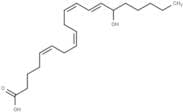
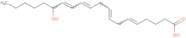
CAS 71030-36-9
:15-Hete
Description:
15-HETE, or 15-hydroxyeicosatetraenoic acid, is a bioactive lipid derived from arachidonic acid through the action of lipoxygenase enzymes. It is classified as an eicosanoid, a group of signaling molecules that play crucial roles in various physiological processes. 15-HETE is known for its involvement in inflammatory responses, cell signaling, and modulation of vascular functions. It exhibits anti-inflammatory properties and can influence cell proliferation and apoptosis. The substance is typically found in various tissues and is implicated in several biological pathways, including those related to cardiovascular health and immune responses. Its presence in biological systems can be measured using advanced analytical techniques such as mass spectrometry. As a research compound, 15-HETE is of interest in studies related to inflammation, cancer, and cardiovascular diseases, making it a significant focus in pharmacological and biomedical research.
Formula:C20H32O3
InChI:InChI=1/C20H32O3/c1-2-3-13-16-19(21)17-14-11-9-7-5-4-6-8-10-12-15-18-20(22)23/h4-5,8-11,14,17,19,21H,2-3,6-7,12-13,15-16,18H2,1H3,(H,22,23)/b5-4-,10-8-,11-9-,17-14+
InChI key:InChIKey=JSFATNQSLKRBCI-USWFWKISNA-N
SMILES:C(=C/C=C\C/C=C\C/C=C\CCCC(O)=O)\C(CCCCC)O
Synonyms:- (±)15-HETE MaxSpec Standard
- 5,8,11,13-Eicosatetraenoic acid, 15-hydroxy-, (5Z,8Z,11Z,13E)-
- 15(S)-Hydroxy-5(Z),8(Z),11(Z),13(E)-eicosatetraenoic acid [15(S)-HETE
- 15(S)-HETE SOLUTION
- (5Z,8Z,11Z,13E)-15-HETE
Sort by
Purity (%)
0
100
|
0
|
50
|
90
|
95
|
100
Found 3 products.
15-hydroxy-5(Z),8(Z),11(Z),13(E)-eicosatetraenoic acid
CAS:Formula:C20H32O3Purity:>98%Color and Shape:In solution, EthanolMolecular weight:320.47(±)15-HETE
CAS:(±)15-HETE is a bioactive eicosanoid and a key enzymatic precursor for other lipid derivatives, also functioning as a PROTAC linker for synthesizing protein degradation molecules.Formula:C20H32O3Purity:98%Color and Shape:SolidMolecular weight:320.4715-HETE
CAS:15-HETE is a protein that has been found to be associated with cancer. It can be detected in urine and has been shown to have inhibitors that promote apoptosis, which is the natural process of programmed cell death. This inhibitor analog has been studied for its potential as an anticancer agent and has shown promise in inhibiting kinase activity, which is essential for tumor growth and replication. 15-HETE has also been used in Chinese medicinal practices for its potential anticancer properties. Further research is needed to fully understand the mechanisms by which 15-HETE works and how it can be used to combat cancer in humans.Formula:C20H32O3Purity:Min. 95%Molecular weight:320.5 g/mol