CAS 7115-16-4
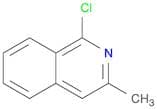
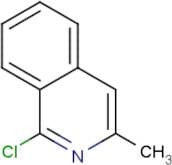
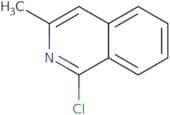
:1-Chloro-3-methylisoquinoline
Description:
1-Chloro-3-methylisoquinoline is a heterocyclic organic compound characterized by its isoquinoline structure, which consists of a fused benzene and pyridine ring. The presence of a chlorine atom at the first position and a methyl group at the third position of the isoquinoline framework defines its unique properties. This compound typically appears as a yellow to brown liquid or solid, depending on its purity and form. It is known for its potential applications in medicinal chemistry, particularly in the development of pharmaceuticals, due to its ability to interact with biological targets. The compound is generally soluble in organic solvents but may have limited solubility in water. Its reactivity is influenced by the presence of the chlorine atom, which can participate in nucleophilic substitution reactions. Safety precautions should be taken when handling this compound, as it may pose health risks, including irritation to the skin and respiratory system. Proper storage in a cool, dry place away from light is recommended to maintain its stability.
Formula:C10H8ClN
InChI:InChI=1/C10H8ClN/c1-7-6-8-4-2-3-5-9(8)10(11)12-7/h2-6H,1H3
SMILES:Cc1cc2ccccc2c(Cl)n1
Synonyms:- Isoquinoline, 1-chloro-3-methyl-
- T66 Cnj Bg D1 [Wln]
Sort by
Purity (%)
0
100
|
0
|
50
|
90
|
95
|
100
Found 4 products.
1-Chloro-3-methyl-isoquinoline
CAS:1-Chloro-3-methyl-isoquinolinePurity:97%Molecular weight:177.63g/mol1-Chloro-3-methyl-isoquinoline
CAS:Formula:C10H8ClNPurity:95.0%Color and Shape:SolidMolecular weight:177.631-Chloro-3-methyl-isoquinoline
CAS:1-Chloro-3-methyl-isoquinoline is a cytotoxic compound with potent anti-cancer activity. It exhibits cytotoxicity against cancer cell lines and alkylation of DNA, which may be due to its ability to bind to the colchicine binding site on the cancer cell. 1-Chloro-3-methyl-isoquinoline has been shown to exhibit low yields in synthesis, but these can be improved by using phthalidyl as an intermediate. The chlorination of 1-chloro-3-methyl isoquinoline leads to the production of a heterocycle that is subsequently decarboxylated.Formula:C10H8ClNPurity:Min. 95%Molecular weight:177.63 g/mol