CAS 7149-90-8
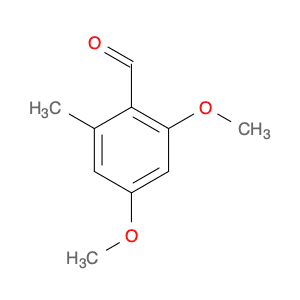
:2,4-dimethoxy-6-methylbenzaldehyde
Description:
2,4-Dimethoxy-6-methylbenzaldehyde, with the CAS number 7149-90-8, is an organic compound belonging to the class of aromatic aldehydes. It features a benzene ring substituted with two methoxy groups at the 2 and 4 positions, a methyl group at the 6 position, and an aldehyde functional group at the 1 position. This compound is typically characterized by its pleasant aromatic odor, which is often utilized in the fragrance industry. It is a colorless to pale yellow liquid at room temperature and is soluble in organic solvents such as ethanol and ether, but has limited solubility in water due to its hydrophobic nature. The presence of the aldehyde group makes it reactive, particularly in condensation reactions and nucleophilic additions. Additionally, the methoxy groups can influence its reactivity and stability, often enhancing its electron-donating properties. Safety precautions should be taken when handling this compound, as with many organic chemicals, due to potential irritant effects and toxicity.
Formula:C10H12O3
InChI:InChI=1/C10H12O3/c1-7-4-8(12-2)5-10(13-3)9(7)6-11/h4-6H,1-3H3
SMILES:Cc1cc(cc(c1C=O)OC)OC
Sort by
Purity (%)
0
100
|
0
|
50
|
90
|
95
|
100
Found 4 products.
2,4-Dimethoxy-6-methylbenzaldehyde
CAS:2,4-Dimethoxy-6-methylbenzaldehyde is a biomolecular that belongs to the class of depsidones. It is a tetracyclic compound that has been isolated from the fungus Antrodia camphorata and the lichen Xanthoria polycarpa. 2,4-Dimethoxy-6-methylbenzaldehyde has been shown to inhibit the growth of fungi by preventing oxidative phosphorylation in mitochondria. This compound also shows regioselectivity for phenanthrenes, which are aromatic hydrocarbons with two benzene rings and one or more methyl groups on each ring. The synthesis of 2,4-dimethoxy-6-methylbenzaldehyde is achieved through a Witting reaction between olefinic compounds and diethyl malonate in the presence of base. 2,4-Dimethoxy-6-methylbenzaldehyde can also be synthesized by oxidizing dibFormula:C10H12O3Purity:Min. 95%Color and Shape:PowderMolecular weight:180.2 g/mol