CAS 71516-35-3
:2-methyl-3-nitrobenzonitrile
Description:
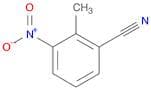
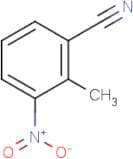
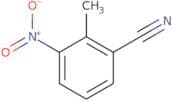
2-Methyl-3-nitrobenzonitrile, with the CAS number 71516-35-3, is an organic compound characterized by the presence of both a nitrile and a nitro functional group on a benzene ring. Its molecular structure consists of a benzene ring substituted with a methyl group at the second position and a nitro group at the third position, along with a cyano group (-C≡N) attached to the benzene. This compound typically appears as a solid at room temperature and is known for its aromatic properties, which contribute to its stability and reactivity. It is often used in organic synthesis and may serve as an intermediate in the production of pharmaceuticals or agrochemicals. The presence of the nitro group can impart specific reactivity, making it a useful building block in various chemical reactions. Additionally, like many nitro compounds, it may exhibit some degree of toxicity and should be handled with appropriate safety precautions in laboratory settings.
Formula:C8H6N2O2
InChI:InChI=1/C8H6N2O2/c1-6-7(5-9)3-2-4-8(6)10(11)12/h2-4H,1H3
SMILES:Cc1c(cccc1N(=O)=O)C#N
Synonyms:- 2-Cyano-6-Nitrotoluene
Sort by
Purity (%)
0
100
|
0
|
50
|
90
|
95
|
100
Found 4 products.
2-Methyl-3-nitrobenzonitrile
CAS:Formula:C8H6N2O2Purity:98%Color and Shape:SolidMolecular weight:162.14542-Methyl-3-nitrobenzonitrile
CAS:Formula:C8H6N2O2Purity:98%Color and Shape:SolidMolecular weight:162.1482-Methyl-3-nitrobenzonitrile
CAS:2-Methyl-3-nitrobenzonitrile is a colorless crystalline solid with a melting point of -81.8°C and a boiling point of 206.6°C. The crystal structure is shown to be an oriented, six-membered ring with hydrogen bonds and conformations that are asymmetric and dihedral. It has the molecular formula C7H5N3O2, which consists of three methyl groups and one nitro group on the benzene nucleus. 2-Methyl-3-nitrobenzonitrile is used as a starting material in organic synthesis reactions because it can undergo electrophilic substitution reactions with alkyl halides or Grignard reagents to form substituted benzenes.Formula:C8H6N2O2Purity:Min. 95%Molecular weight:162.15 g/mol