CAS 7154-85-0
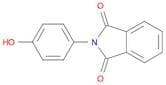
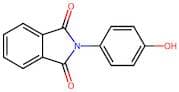
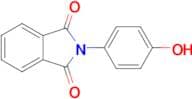
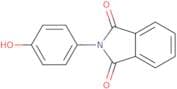
:N-(4-Hydroxyphenyl)phthalimide
Description:
N-(4-Hydroxyphenyl)phthalimide, with the CAS number 7154-85-0, is an organic compound characterized by its phthalimide structure substituted with a 4-hydroxyphenyl group. This compound typically appears as a white to off-white crystalline solid. It is known for its potential applications in various fields, including pharmaceuticals and materials science, due to its ability to act as a precursor in organic synthesis and as a reagent in chemical reactions. The presence of the hydroxyl group enhances its reactivity and solubility in polar solvents. N-(4-Hydroxyphenyl)phthalimide may exhibit biological activity, making it of interest in medicinal chemistry. Its melting point, solubility, and specific reactivity can vary based on environmental conditions and the presence of other chemical species. As with many organic compounds, proper handling and safety precautions are essential, as it may pose health risks if ingested or inhaled. Overall, this compound represents a versatile building block in organic synthesis and research applications.
Formula:C14H9NO3
InChI:InChI=1/C14H9NO3/c16-10-7-5-9(6-8-10)15-13(17)11-3-1-2-4-12(11)14(15)18/h1-8,16H
SMILES:c1ccc2c(c1)C(=O)N(c1ccc(cc1)O)C2=O
Synonyms:- 2-(4-hydroxyphenyl)-1H-isoindole-1,3(2H)-dione
Sort by
Purity (%)
0
100
|
0
|
50
|
90
|
95
|
100
Found 4 products.
N-(4-HYDROXYPHENYL)PHTHALIMIDE
CAS:Formula:C14H9NO3Purity:95%Color and Shape:SolidMolecular weight:239.22622-(4-Hydroxyphenyl)isoindoline-1,3-dione
CAS:2-(4-Hydroxyphenyl)isoindoline-1,3-dionePurity:98%Molecular weight:239.23g/molN-(4-Hydroxyphenyl)phthalimide
CAS:N-(4-Hydroxyphenyl)phthalimide is a white powder that has a melting point of 140.5°C, and is soluble in chloroform, acetone, and ethanol. It has the chemical formula C6H4N(OH)C6H3(OCH2CH2)2 and is used as a reagent for the synthesis of phthalic anhydride. It reacts with ammonia to form phthalamide. This compound belongs to the family of compounds called phthalimides. The molecule consists of two benzene rings connected by a single bond, which contains two hydroxyl groups on opposite sides of the ring system. Hydrogen bonds are formed between these hydroxyl groups and other atoms in the molecule. These hydrogen bonds contribute to the dihedral angle of this molecule (104°).Formula:C14H9NO3Purity:Min. 95%Molecular weight:239.23 g/mol