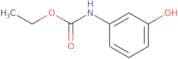
CAS 7159-96-8
:Ethyl 3-hydroxyphenylcarbamate
Description:
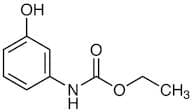
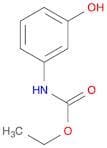
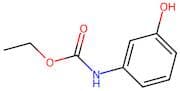
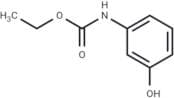
Ethyl 3-hydroxyphenylcarbamate, with the CAS number 7159-96-8, is an organic compound characterized by its carbamate functional group and a phenolic structure. It typically appears as a white to off-white solid or crystalline powder. This compound is known for its potential applications in pharmaceuticals and agrochemicals, often serving as an intermediate in the synthesis of various bioactive molecules. Ethyl 3-hydroxyphenylcarbamate exhibits moderate solubility in organic solvents, while its solubility in water may vary depending on pH and temperature. The presence of the hydroxy group contributes to its reactivity and ability to form hydrogen bonds, influencing its biological activity and interactions with other substances. Additionally, this compound may possess antioxidant properties, making it of interest in research related to health and disease prevention. As with many chemical substances, proper handling and safety precautions are essential due to potential toxicity or environmental impact.
Formula:C9H11NO3
InChI:InChI=1/C9H11NO3/c1-2-13-9(12)10-7-4-3-5-8(11)6-7/h3-6,11H,2H2,1H3,(H,10,12)
InChI key:InChIKey=KCLZXXMMEDEBMF-UHFFFAOYSA-N
SMILES:N(C(OCC)=O)C1=CC(O)=CC=C1
Synonyms:- (3-Hydroxy-Phenyl)-Carbamic Acid Ethyl Ester
- (3-Hydroxyphenyl)carbamic acid ethyl ester
- 3-(Ethoxycarbonylamino)phenol
- 3-Carbethoxyaminophenol
- 3-Ethyloxycarbonylaminophenol
- Carbamic acid, (3-hydroxyphenyl)-, ethyl ester
- Carbamic acid, N-(3-hydroxyphenyl)-, ethyl ester
- Carbanilic acid, m-hydroxy-, ethyl ester
- Carbanilic acid, m-hydroxy-, ethyl esters
- Ethyl (m-hydroxyphenyl)carbamate
- Ethyl 3-hydroxycarbanilate
- Ethyl 3-hydroxyphenylcarbamate
- Ethyl N-(3-hydroxyphenyl)carbamate
- NSC 222551
- m-(Ethoxycarbonylamino)phenol
- Ethyl (3-hydroxyphenyl)carbamate
- Ethyl-3-hydroxyphenolcarbamate
- (3-hydroxyphenyl)-carbamicaciethylester
- ethyln-(3-hydroxyphenyl)carbamate
- ethylm-hydroxycarbanilate
- N-(3-Hydroxyphenyl)carbamic acid ethyl ester
- (3-Hydroxy-Phenyl)-carbanicacid ethyl ester
- m-hydroxy-carbanilicaciethylester
- ethyl3-hydroxycarbanilate
- AKOS BBS-00008072
- See more synonyms
Sort by
Purity (%)
0
100
|
0
|
50
|
90
|
95
|
100
Found 6 products.
Ethyl (3-Hydroxyphenyl)carbamate
CAS:Formula:C9H11NO3Purity:>97.0%(GC)Color and Shape:White to Light yellow powder to crystalMolecular weight:181.19Ethyl (3-hydroxyphenyl)carbamate
CAS:Formula:C9H11NO3Purity:%Color and Shape:SolidMolecular weight:181.1885Ethyl 3-Hydroxyphenylcarbamate
CAS:Ethyl 3-HydroxyphenylcarbamatePurity:99%Molecular weight:181.18854g/molEthyl (3-hydroxyphenyl)carbamate
CAS:Ethyl (3-hydroxyphenyl)carbamate is a bioactive chemical.Formula:C9H11NO3Purity:98%Color and Shape:SolidMolecular weight:181.19Ethyl (3-hydroxyphenyl)carbamate
CAS:Formula:C9H11NO3Purity:95+%Color and Shape:SolidMolecular weight:181.191Ethyl (3-Hydroxyphenyl)carbamate
CAS:Ethyl (3-Hydroxyphenyl)carbamate is a carbonyl group that is produced by the hydrolysis of triticum aestivum. This product has been shown to have a synergistic interaction with retroflexus and bioassay, an imaging technique used to measure the photosynthetic activity of plants. Ethyl (3-Hydroxyphenyl)carbamate has low light fluorescence properties, which are useful for the detection of sugarbeet in low light conditions. The symptoms of ethyl (3-hydroxyphenyl)carbamate exposure include a constant and acceptor, which is a molecule or atom that accepts electrons from an electron donor in chemical reactions. Ethyl (3-hydroxyphenyl)carbamate can react with proton to form arvensis, a sugar found in sugarbeets.
Formula:C9H11NO3Purity:Min. 95%Molecular weight:181.19 g/mol