CAS 71637-37-1
:2-Thiopheneacetonitrile,5-bromo-
Description:
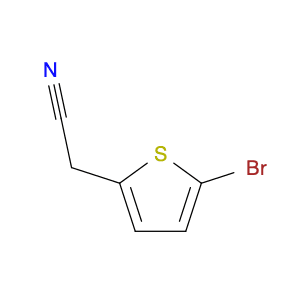
2-Thiopheneacetonitrile, 5-bromo- is an organic compound characterized by the presence of a thiophene ring, which is a five-membered aromatic heterocycle containing sulfur. The compound features a bromine atom substituted at the 5-position of the thiophene ring and an acetonitrile functional group attached to the 2-position. This structure imparts unique chemical properties, including potential reactivity in nucleophilic substitution reactions due to the presence of the acetonitrile group. The bromine substituent can also serve as a leaving group in various synthetic applications. The compound is typically used in organic synthesis and may serve as an intermediate in the production of pharmaceuticals or agrochemicals. Its physical properties, such as solubility and melting point, can vary based on the specific conditions and purity of the sample. As with many brominated compounds, it is important to handle it with care due to potential environmental and health impacts.
Formula:C6H4BrNS
Synonyms:- 5-Bromo-2-thiophenacetonitrile
- 5-Bromo-2-thiopheneacetonitrile
- (5-Bromo-Thiophen-2-Yl)-Acetonitrile
Sort by
Purity (%)
0
100
|
0
|
50
|
90
|
95
|
100
Found 4 products.
2-(5-Bromothiophen-2-yl)acetonitrile
CAS:Formula:C6H4BrNSPurity:95%Color and Shape:SolidMolecular weight:202.07172-(5-Bromothiophen-2-yl)acetonitrile
CAS:2-(5-Bromothiophen-2-yl)acetonitrilePurity:99%Molecular weight:202.07g/mol2-(5-Bromothiophen-2-yl)acetonitrile
CAS:2-(5-Bromothiophen-2-yl)acetonitrile is an acceptor in organic solar cells and devices. It has a molecular weight of 122.1 g/mol and a melting point of -34 °C, with a solubility of 0.0013g/mL in water. The UV absorption spectrum shows that it absorbs at wavelengths between 270-300 nm. 2-(5-Bromothiophen-2-yl)acetonitrile can be used as an electron donor for semiconducting heterojunction photovoltaic devices and has been shown to have good transport properties. This molecule also has molecular orbitals that are lower than those found in the ground state, which may be due to the presence of hydrogen bonding groups on the phenyl rings or the presence of electron donating groups such as nitro (-NO2) or cyano (-CN).
Formula:C6H4NSBrPurity:Min. 95%Molecular weight:202.07 g/mol