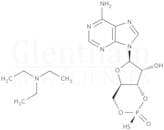
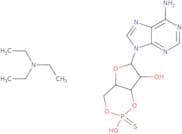
CAS 71774-13-5
:(S)-Adenosine 3′,5′-cyclic monophosphorothioate
Description:
(S)-Adenosine 3′,5′-cyclic monophosphorothioate, with the CAS number 71774-13-5, is a nucleotide analog that plays a significant role in biochemical research, particularly in studies involving signal transduction and cellular signaling pathways. This compound is a derivative of adenosine, featuring a cyclic structure that includes a phosphorothioate group, which replaces one of the oxygen atoms in the phosphate moiety with sulfur. This modification enhances its stability against enzymatic degradation, making it a valuable tool in experimental settings. The stereochemistry of the compound, indicated by the "(S)" designation, refers to the specific three-dimensional arrangement of atoms, which can influence its biological activity and interaction with various enzymes and receptors. As a cyclic nucleotide, it is involved in the regulation of various physiological processes, including cell growth, differentiation, and apoptosis. Its unique properties make it a subject of interest in pharmacological studies and the development of therapeutic agents targeting specific signaling pathways.
Formula:C10H12N5O5PS
InChI:InChI=1S/C10H12N5O5PS/c11-8-5-9(13-2-12-8)15(3-14-5)10-6(16)7-4(19-10)1-18-21(17,22)20-7/h2-4,6-7,10,16H,1H2,(H,17,22)(H2,11,12,13)/t4-,6-,7-,10-,21+/m1/s1
InChI key:InChIKey=SMPNJFHAPJOHPP-LHKKBNDGSA-N
SMILES:O[C@H]1[C@H](N2C=3C(N=C2)=C(N)N=CN3)O[C@]4([C@]1(OP(=O)(S)OC4)[H])[H]
Synonyms:- Adenosine, cyclic 3′,5′-(hydrogen phosphorothioate), (S)-
- 4H-Furo[3,2-d]-1,3,2-dioxaphosphorin, adenosine deriv.
- Adenosine, cyclic 3′,5′-[hydrogen (S)-phosphorothioate]
- (S)-Adenosine 3′,5′-cyclic monophosphorothioate
Sort by
Purity (%)
0
100
|
0
|
50
|
90
|
95
|
100
Found 3 products.
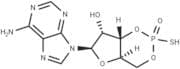
Adenosine 3',5'-cyclic monophosphothioate Sp-isomer sodium salt
CAS:Adenosine 3',5'-cyclic monophosphothioate Sp-isomer sodium salt (CMPT) is a neurotrophic factor that belongs to the class of adenosine 3',5'-cyclic monophosphates. It has been shown to induce neuronal differentiation and neurite outgrowth in a model system. CMPT has also been shown to have neuroprotective effects by ameliorating the severity of Parkinson's disease symptoms. This drug has been shown to increase body mass index and IGF-I levels in vivo. CMPT has been demonstrated to inhibit tumor growth through upregulation of the cytosolic Ca2+ level, which leads to apoptosis. CMPT can be used as a pharmacological treatment for Alzheimer's disease, Parkinson's disease, and other neurodegenerative disorders.
Formula:C10H11N5O5PS·NaPurity:Min. 95%Color and Shape:White PowderMolecular weight:367.25 g/molSp-cAMPS
CAS:Rp-cAMPS TEA salt is a cAMP-dependent protein kinase (PKA) activator.Formula:C10H12N5O5PSColor and Shape:SolidMolecular weight:345.27