CAS 719-22-2
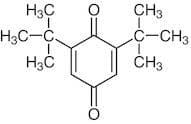
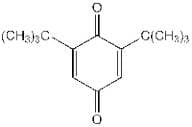
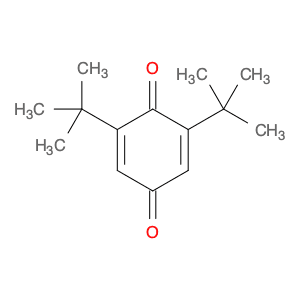
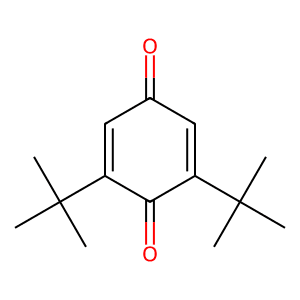
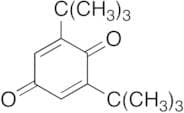
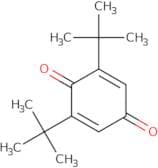
:2,6-Di-tert-butyl-1,4-benzoquinone
Description:
2,6-Di-tert-butyl-1,4-benzoquinone is an organic compound characterized by its quinone structure, which features two tert-butyl groups at the 2 and 6 positions of the benzene ring. This compound is known for its strong antioxidant properties, making it useful in various applications, including as a stabilizer in polymers and as a reagent in organic synthesis. It is typically a yellow to orange solid at room temperature and is soluble in organic solvents such as acetone and chloroform, but has limited solubility in water. The presence of the bulky tert-butyl groups contributes to its steric hindrance, influencing its reactivity and stability. Additionally, 2,6-Di-tert-butyl-1,4-benzoquinone can undergo redox reactions, allowing it to participate in electron transfer processes. Safety precautions should be taken when handling this compound, as it may pose health risks if inhaled or ingested. Overall, its unique structural features and properties make it a valuable compound in both industrial and research settings.
Formula:C14H20O2
InChI:InChI=1/C14H20O2/c1-13(2,3)10-7-9(15)8-11(12(10)16)14(4,5)6/h7-8H,1-6H3
InChI key:InChIKey=RDQSIADLBQFVMY-UHFFFAOYSA-N
SMILES:C(C)(C)(C)C=1C(=O)C(C(C)(C)C)=CC(=O)C1
Synonyms:- 2,5-Cyclohexadiene-1,4-dione, 2,6-bis(1,1-dimethylethyl)-
- 2,6-Bis(1,1-dimethylethyl)-2,5-cyclohexadiene-1,4-dione
- 2,6-Bis[1,1-dimethyl ethyl]quinone
- 2,6-Di-Tert-Butyl-P-Benzoquinon
- 2,6-Di-Tert-Butylcyclohexa-2,5-Diene-1,4-Dione
- 2,6-Di-tert-butyl-1,4-benzoquinone
- 2,6-Di-tert-butyl-2,5-cyclohexadien-1,4-dione
- 2,6-Di-tert-butyl-2,5-cyclohexadiene-1,4-dione
- 2,6-Di-tert-butyl-p-quinone
- 2,6-Di-tert-butylbenzoquinone
- 2,6-Di-tert-butylquinone
- 2,6-Ditert-butylcyclohexa-2,5-diene-1,4-dione
- 3,5-Di-tert-butyl-p-benzoquinone
- 3,5-Di-tert-butylquinone
- Dibutylpbenzoquinone
- NSC 14448
- p-Benzoquinone, 2,6-di-tert-butyl-
- DBQ
- 2,5-Cyclohexadiene-1,4-dione,2,6-
- 2,6-Di-tert-butyl-p-benzoquinone, 98+%
- 2,6-DI(TERT-BUTYL)BENZO-1,4-QUINONE
- 4-dione,2,6-bis(1,1-dimethylethyl)-5-cyclohexadiene-1
- 2,6-DI-T-BUTYL-1,4-BENZOQUINONE
- 2,6-di-tert-Butyl-p-benzoquino
- p-Benzoquinone, 2,6-bis-(1,1-dimethylethyl)
- 2,6-DI-T-BUTYL-P-BENZOQUINONE
- 2,6-DI-TERT-BUTYL-P-BENZOQUINONE
- Benzoquinone, 2,6-di-(1,1-dimethylethyl)
- See more synonyms
Sort by
Purity (%)
0
100
|
0
|
50
|
90
|
95
|
100
Found 8 products.
2,6-Di-tert-butyl-1,4-benzoquinone
CAS:Formula:C14H20O2Purity:>98.0%(GC)Color and Shape:Light yellow to Yellow to Orange powder to crystalMolecular weight:220.312,6-Di-tert-butyl-p-benzoquinone, 98+%
CAS:2,6-Di-tert-butyl-1,4-benzoquinone was used as an antioxidant to study the elimination rate of micro pollutant from storm and waste water. It was also used as a metabolite of butylated hydroxytoluene. It is used as a treatment agent to improve germination and plant health. This Thermo Scientific CheFormula:C14H20O2Purity:98+%Color and Shape:Orange, Crystals or crystalline powderMolecular weight:220.312,6-Di-tert-butylcyclohexa-2,5-diene-1,4-dione
CAS:Formula:C14H20O2Purity:98%Color and Shape:SolidMolecular weight:220.30742,6-di(tert-butyl)benzo-1,4-quinone
CAS:2,6-di(tert-butyl)benzo-1,4-quinoneFormula:C14H20O2Purity:98%Color and Shape: yellow solidMolecular weight:220.31g/mol2,6-Di-tert-butyl-p-benzoquinone
CAS:Applications 2.6-Di-tert-butyl-p-benzoquinone was used as a treatment agent to improve germination, plant health and yield.
Formula:C14H20O2Color and Shape:NeatMolecular weight:220.312,6-Di-tert-butylcyclohexa-2,5-diene-1,4-dione
CAS:Formula:C14H20O2Purity:98%Color and Shape:Solid, Reddish yellow to yellow red powderMolecular weight:220.3122,6-Di-tert-butylcyclohexa-2,5-diene-1,4-dione
CAS:2,6-Di-tert-butylcyclohexa-2,5-diene-1,4-dione (BHT) is a chemical compound that is used as an oxygenation catalyst and analytical method. The molecular structure of BHT contains a hydroxyl group with a redox potential of 0.3 V and a thermal expansion coefficient of 7 x 10 K. This compound has been shown to be toxic in mice, causing lung damage and oxidative DNA damage. BHT also inhibits the transcriptional regulation of genes by binding to amines in the cell membrane. It can act as an antioxidant because it binds to reactive oxygen species and prevents them from oxidizing other molecules in the cell. These properties make it useful for protecting cells from oxidative stress caused by reactive oxygen species or peroxides.Formula:C14H20O2Purity:Min. 95%Molecular weight:220.31 g/mol