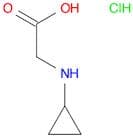
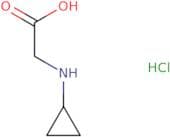
CAS 71922-63-9
:Glycine, N-cyclopropyl-, hydrochloride
Description:
Glycine, N-cyclopropyl-, hydrochloride is a chemical compound characterized by its structure, which includes a glycine backbone with a cyclopropyl group attached to the nitrogen atom. As a hydrochloride salt, it is typically encountered in a crystalline form and is soluble in water, which enhances its utility in various biochemical applications. This compound is of interest in medicinal chemistry and pharmacology due to its potential role as a building block in drug development and its interactions with biological systems. Glycine itself is the simplest amino acid, and modifications like the cyclopropyl group can influence its biological activity and properties. The presence of the hydrochloride indicates that it is in a protonated form, which can affect its stability and solubility. Overall, Glycine, N-cyclopropyl-, hydrochloride is a compound that combines the fundamental characteristics of amino acids with unique structural features that may confer specific functional properties in research and therapeutic contexts.
Formula:C5H9NO2·ClH
InChI:InChI=1S/C5H9NO2.ClH/c7-5(8)3-6-4-1-2-4;/h4,6H,1-3H2,(H,7,8);1H
InChI key:InChIKey=LACZBXBXDSGMGS-UHFFFAOYSA-N
SMILES:N(CC(O)=O)C1CC1.Cl
Synonyms:- Glycine, N-cyclopropyl-, hydrochloride
Sort by
Purity (%)
0
100
|
0
|
50
|
90
|
95
|
100
Found 3 products.
2-(cyclopropylamino)acetic acid hydrochloride
CAS:Formula:C5H10ClNO2Purity:95%Molecular weight:151.59142-(cyclopropylamino)acetic acid hydrochloride
CAS:<p>2-(Cyclopropylamino)acetic acid hydrochloride is a hydrogen atom donor and an antibacterial agent. It is used in pharmaceutical preparations for the treatment of bacterial infections. 2-(Cyclopropylamino)acetic acid hydrochloride inhibits the growth of bacteria by inhibiting the synthesis of their cell walls, which are made up of polymers of amino acids linked to each other by peptide bonds. This compound has been shown to be effective against Gram-negative bacteria, such as Acinetobacter baumannii and Pseudomonas aeruginosa, as well as some Gram-positive bacteria, such as Staphylococcus aureus. 2-(Cyclopropylamino)acetic acid hydrochloride also has an inhibitory effect on phosphoric acid bacteria and can be used to synthesize α-amino acids.</p>Formula:C5H10ClNO2Purity:Min. 95%Molecular weight:151.59 g/mol