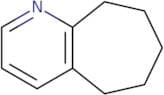
![6,7,8,9-Tetrahydro-5H-cyclohepta[b]pyridine](/_next/image/?url=https%3A%2Fstatic.cymitquimica.com%2Fcas-image%2Fthumb-webp%2F555777-6789-tetrahydro-5h-cyclohepta-b-pyridine.webp&w=3840&q=75)
CAS 7197-96-8
:6,7,8,9-Tetrahydro-5H-cyclohepta[b]pyridine
Description:
6,7,8,9-Tetrahydro-5H-cyclohepta[b]pyridine, with the CAS number 7197-96-8, is a bicyclic organic compound characterized by its unique structure that includes a saturated cycloheptane ring fused to a pyridine ring. This compound is typically colorless to pale yellow and exhibits a relatively low molecular weight. It is known for its potential applications in medicinal chemistry, particularly as a building block for various pharmaceuticals due to its ability to interact with biological systems. The presence of nitrogen in the pyridine ring contributes to its basicity and reactivity, allowing for various chemical modifications. Additionally, the compound's saturated nature may influence its solubility and stability in different solvents. Its properties, such as boiling point and melting point, can vary based on purity and environmental conditions. Overall, 6,7,8,9-Tetrahydro-5H-cyclohepta[b]pyridine is of interest in research for its structural features and potential biological activity.
Formula:C10H13N
InChI:InChI=1S/C10H13N/c1-2-5-9-6-4-8-11-10(9)7-3-1/h4,6,8H,1-3,5,7H2
InChI key:InChIKey=CULUYAUTCSKQNM-UHFFFAOYSA-N
SMILES:C=12C(=NC=CC1)CCCCC2
Synonyms:- 5H-Cyclohepta[b]pyridine, 6,7,8,9-tetrahydro-
- 2,3-Cycloheptenopyridine
- 6,7,8,9-Tetrahydro-5H-cyclohepta[b]pyridine
Sort by
Purity (%)
0
100
|
0
|
50
|
90
|
95
|
100
Found 4 products.
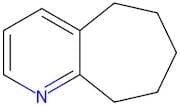
2,3-Cycloheptenopyridine
CAS:Formula:C10H13NPurity:95%Color and Shape:LiquidMolecular weight:147.21692,3-Cycloheptenopyridine
CAS:2,3-Cycloheptenopyridine is a molybdenum metal complex with chloroform. It belongs to the class of nucleophilic complexes. The reaction product of cycloheptenopyridine n-oxide and formaldehyde, it has a spectrum that shows peaks at 521 nm and 609 nm. This complex can be prepared by reacting 2,3-cycloheptenopyridine with hydrogen peroxide in dimethylformamide as a reagent. 2,3-Cycloheptenopyridine is an example of an n-oxide because it contains both oxygen atoms in the same molecule. The two isomers are cis and trans, but only the cis form is known to exist naturally on Earth. The trans isomer can be synthesized through the use of peroxides or trioxides; however, this synthetic form is only stable at temperatures above 300°C.Formula:C10H13NPurity:Min. 95%Molecular weight:147.22 g/mol



![6,7,8,9-TETRAHYDRO-5H-CYCLOHEPTA[B]PYRIDINE](/_next/image/?url=https%3A%2Fstatic.cymitquimica.com%2Fproducts%2F10%2Fthumb%2FF832391.jpg&w=3840&q=75)