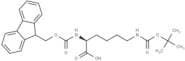
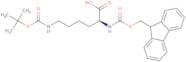
CAS 71989-26-9
:Fmoc-Lys(Boc)-OH
Description:
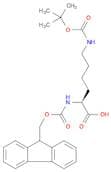
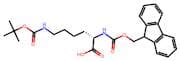
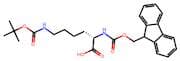
Fmoc-Lys(Boc)-OH, also known as Fmoc-Lysine(Boc)-OH, is a protected amino acid commonly used in peptide synthesis. It features a lysine residue with two protective groups: the Fmoc (9-fluorenylmethoxycarbonyl) group, which is used to protect the amino group, and the Boc (tert-butyloxycarbonyl) group, which protects the side chain amino group of lysine. This compound is typically a white to off-white solid and is soluble in organic solvents such as dimethylformamide (DMF) and dimethyl sulfoxide (DMSO), but less soluble in water. The presence of these protective groups allows for selective deprotection during the synthesis of peptides, facilitating the construction of complex peptide sequences. Fmoc-Lys(Boc)-OH is widely utilized in solid-phase peptide synthesis (SPPS) due to its stability and ease of handling. Its molecular structure includes a primary amine, a carboxylic acid, and two bulky protective groups, which contribute to its unique reactivity and compatibility in various synthetic pathways.
Formula:C26H32N2O6
InChI:InChI=1S/C26H32N2O6/c1-26(2,3)34-24(31)27-15-9-8-14-22(23(29)30)28-25(32)33-16-21-19-12-6-4-10-17(19)18-11-5-7-13-20(18)21/h4-7,10-13,21-22H,8-9,14-16H2,1-3H3,(H,27,31)(H,28,32)(H,29,30)/t22-/m0/s1
InChI key:InChIKey=UMRUUWFGLGNQLI-QFIPXVFZSA-N
SMILES:C(OC(N[C@@H](CCCCNC(OC(C)(C)C)=O)C(O)=O)=O)C1C=2C(C=3C1=CC=CC3)=CC=CC2
Synonyms:- (2S)-2-(9H-Fluoren-9-ylmethoxycarbonylamino)-6-[(2-methylpropan-2-yl)oxycarbonylamino]hexanoic acid
- (2S)-6-(tert-Butoxycarbonylamino)-2-[[[(9H-fluoren-9-yl)methoxy]carbonyl]amino]hexanoic acid
- (S)-2-[[[(9H-Fluoren-9-yl)methoxy]carbonyl]amino]-6-(tert-butoxycarbonylamino)hexanoic acid
- (S)-6-[(tert-Butoxycarbonyl)amino]-2-[[[(9H-fluoren-9-yl)methoxy]carbonyl]amino]hexanoic acid
- <span class="text-smallcaps">L</span>-Lysine, N<sup>6</sup>-[(1,1-dimethylethoxy)carbonyl]-N<sup>2</sup>-[(9H-fluoren-9-ylmethoxy)carbonyl]-
- Fmoc-L-Lys(Boc)-OH
- N-Alpha-Fmoc-Nepsilon-Boc-L-Lysine
- N-α-(Fmoc)-N-ε-(t-boc)-<span class="text-smallcaps">L</span>-Lysine-OH
- N-α-Fluorenylmethoxycarbonyl-N-ε-tert-butoxycarbonyl-<span class="text-smallcaps">L</span>-lysine
- N<sup>6</sup>-[(1,1-Dimethylethoxy)carbonyl]-N<sup>2</sup>-[(9H-fluoren-9-ylmethoxy)carbonyl]-<span class="text-smallcaps">L</span>-lysine
- N<sup>α</sup>-(9-Fluorenylmethoxycarbonyl)-N<sup>ε</sup>-(tert-butoxycarbonyl)lysine
- NSC 334302
- Nalpha-(9-Fluorenylmethoxycarbonyl)-Nepsilon-(Tert-Butoxycarbonyl)-L-Lysine
- Fmoc-Lys(Boc)-OH
- L-Lysine, N6-[(1,1-dimethylethoxy)carbonyl]-N2-[(9H-fluoren-9-ylmethoxy)carbonyl]-
- Nα-(9-Fluorenylmethoxycarbonyl)-Nε-(tert-butoxycarbonyl)lysine
- N-α-(Fmoc)-N-ε-(t-boc)-L-Lysine-OH
- See more synonyms
Sort by
Purity (%)
0
100
|
0
|
50
|
90
|
95
|
100
Found 11 products.
Nε-(tert-Butoxycarbonyl)-Nα-[(9H-fluoren-9-ylmethoxy)carbonyl]-L-lysine
CAS:Formula:C26H32N2O6Purity:>98.0%(T)(HPLC)Color and Shape:White to Almost white powder to crystalMolecular weight:468.55Fmoc-Lys(Boc)-OH
CAS:Bachem ID: 4003151.
Formula:C26H32N2O6Purity:99.7%Color and Shape:WhiteMolecular weight:468.55Fmoc-Lys(Boc)-OH
CAS:Formula:C26H32N2O6Purity:≥ 99.0%Color and Shape:White powderMolecular weight:468.54Fmoc-Lys(Boc)-OH
CAS:Fmoc-Lys(Boc)-OHFormula:C26H32N2O6Purity:97%Color and Shape: white powderMolecular weight:468.54g/molFmoc-Lys(Boc)-OH
CAS:Fmoc-Lys(Boc)-OH (N-α-(Fmoc)-N-ε-(t-boc)-L-Lysine-OH) is a lysine derivative that acts as a reactive linker.Formula:C26H32N2O6Purity:99.89%Color and Shape:SolidMolecular weight:468.54Fmoc-Lys(Boc)-OH
CAS:Fmoc-Lys(Boc)-OH is a monoclonal antibody that reacts with lysine residues. It is synthesized by reacting a solid phase support with an aliphatic hydrocarbon. The reactive functional group on the hydrocarbon terminates in an amine and forms an amide linkage to the amino terminus of the peptide. The hydroxyl terminus of the peptide is then reacted with a trifluoroacetic acid (TFA) ester of lysine in the presence of base. This reaction produces a TFA salt of Fmoc-Lys(Boc)-OH, which can be purified by high salt precipitation or reversed to produce Fmoc-Lys(Boc)-OH by treatment with base. Fmoc-Lys(Boc)-OH has been used as a reagent for chemical conjugation to fluorophores and other molecules such as biotin, avidin, streptFormula:C26H32N2O6Purity:Min. 98.0 Area-%Molecular weight:468.54 g/molFmoc-Lys(Boc)-OH
CAS:Fmoc-Lys(Boc)-OH is a synthetic amino acid that has been used to synthesize polypeptides. It is prepared by the reaction of naphthalene, trifluoroacetic acid and copper (II) acetate in an acidic environment. The synthesis of Fmoc-Lys(Boc)-OH involves the use of a high salt and coordination geometry for the copper complex. This amino acid can be used as a cancer drug, because it inhibits NS3 protease, which is an enzyme that promotes tumor growth. Fmoc-Lys(Boc)-OH also binds to carbohydrate receptors on cancer cells and inhibits uptake of these cells by macrophages.Formula:C26H32N2O6Purity:Min. 98 Area-%Color and Shape:White PowderMolecular weight:468.54 g/molFmoc-Lys(Boc)-OH
CAS:M03419 - Fmoc-Lys(Boc)-OH
Formula:C26H32N2O6Purity:98%Color and Shape:Solid, Powder or Crystalline Powder or Solid or ChunksMolecular weight:468.55Na-FMOC-Ne-BOC-L-Lysine (FMOC-Lys(BOC)-OH) extrapure, 98%
CAS:Formula:C26H32N2O6Purity:min. 98%Color and Shape:White to off-white, Crystalline powderMolecular weight:468.54
![Nε-(tert-Butoxycarbonyl)-Nα-[(9H-fluoren-9-ylmethoxy)carbonyl]-L-lysine](/_next/image/?url=https%3A%2Fstatic.cymitquimica.com%2Fproducts%2F3B%2Fthumb%2FB3072.jpg&w=3840&q=75)