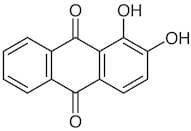
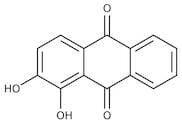
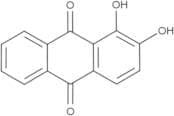
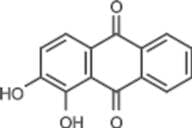
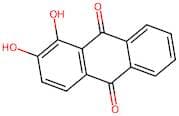
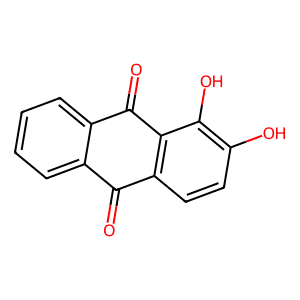
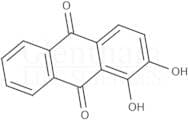
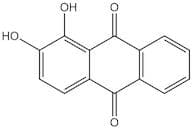
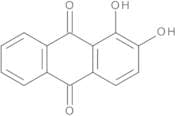
CAS 72-48-0
:Alizarin
- 1,2-Anthraquinonediol
- 1,2-Dihidroxiantraquinona
- 1,2-Dihydroxy-9,10-Anthracenedione
- 1,2-Dihydroxy-9,10-anthraquinone
- 1,2-Dihydroxy-9,10-dihydroanthracene-9,10-dione
- 1,2-Dihydroxyanthracene-9,10-Dione
- 1,2-Dihydroxyanthrachinon
- 1,2-Dihydroxyanthraquinone
- 9,10-Anthracenedione, 1,2-dihydroxy-
- Acid Metachrome Red B
- Acid Mordant Red B
- Alizarin (Dye Content 97%)
- Alizarin B
- Alizarin Red
- Alizarina
- Alizarine
- Alizarine 3B
- Alizarine B
- Alizarine Indicator
- Alizarine L Paste
- Alizarine Lake Red 2P
- Alizarine Lake Red 3P
- Alizarine Lake Red IPX
- Alizarine NAC
- Alizarine Paste 20 percent Bluish
- Alizarine Red
- Alizarine Red B
- Alizarine Red B2
- Alizarine Red IP
- Alizarine Red IPP
- Alizarine Red L
- Anthraquinone, 1,2-Dihydroxy-
- C Ext. Red 62
- Certiqual Alizarine
- Craon 17-503
- Csu 1585
- D And C Orange Number 15
- Deep Crimson Madder 10821
- Eljon Madder
- Mitsui Alizarine B
- Mordant Red 11
- Nsc 7212
- Qiansu
- Rubican
- Turkey red
- See more synonyms
Alizarin
CAS:Formula:C14H8O4Purity:>95.0%(HPLC)Color and Shape:Orange to Brown powder to crystalMolecular weight:240.21Alizarin, 94%
CAS:Alizarin has a major application in the manufacture of the madder lake pigments which is commonly called as Rose madder and Alizarin crimson. It is involved in the studies of bone growth, osteoporosis, bone marrow and calcium deposits in the vascular system. It is also used as a stain in calcite andFormula:C14H8O4Purity:94%Color and Shape:Orange to brown, PowderMolecular weight:240.21Alizarin
CAS:Alizarin analytical standard provided with chromatographic purity, to be used as reference material for qualitative determination.Formula:C14H8O4Purity:(HPLC) ≥95%Color and Shape:PowderMolecular weight:240.21Alizarin
CAS:Alizarin, red dye from madder roots, inhibits CYP1A1 (IC50=6.2μM), CYP1A2 (IC50=10μM), CYP1B1 (IC50=2.7μM).Formula:C14H8O4Purity:98.62%Color and Shape:Orange-Red Crystals Or PowderMolecular weight:240.21Alizarin (C.I. 58000)
CAS:Formula:C14H8O4Purity:≥ 95.0%Color and Shape:Yellow-orange to brown powderMolecular weight:240.21Alizarin
CAS:QuinoneFormula:C14H8O4Purity:≥ 95.0 % (HPLC)Color and Shape:PowderMolecular weight:240.22Alizarin
CAS:Applications Alizarin is used widely as a prominent red dye for textile facbrics. Alizarin red is now used in biochemical assay to determine quantitatively by colorimetry, the presence of calcific deposition by cells of the osteogenic lineage. Alzarine derivatives was evaluated as new inhibitors of the HIV-1 reverse transcriptase associated DNA polymerase and RNase H. Alizarin was also shown to inhibit proliferation, tumor growth and suppress tumorigenesis in human osteosarcoma and breast cancer cell representative for bone metastasis. Dyes and metabolites.
References Yuan, H.S., et al.: Mycol., 3, 100 (2012); Esposito, F. et al.: FEBS. J., 278, 1444 (2011); Fotia, Caterina, J. Orthop. Rsch. 30, 1486 (2012);Formula:C14H8O4Color and Shape:NeatMolecular weight:240.211,2-Dihydroxyanthracene-9,10-dione
CAS:Formula:C14H8O4Purity:97%Color and Shape:Solid, PowderMolecular weight:240.214Alizarin
CAS:Alizarin, traditionally obtained from the roots of the madder plant, has been used to dye textiles since early days. Alizarin red is used in histology and medicine to stain calcium-containing specimens, e.g. bones and calcifications. Chromogenic substrates for enzymes based on alizarin have been developed and, as an example, alizarin-beta-D-galactoside (Aliz-gal) has been reported for the detection of bacterial beta-galactosidase by researchers at the University of Northumbria and the Freeman Hospital, Newcastle upon Tyne in the UK (James, 2000)
Formula:C14H8O4Purity:Min. 95%Color and Shape:Yellow PowderMolecular weight:240.21 g/molRef: 3D-FA39740
Discontinued product