CAS 721-50-6
:Prilocaine
Description:
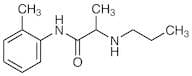
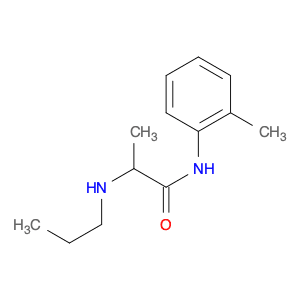
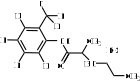
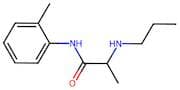
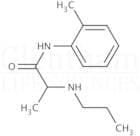
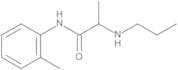
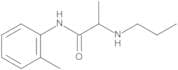
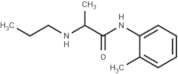
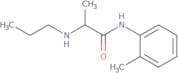
Prilocaine is a local anesthetic belonging to the amide class, primarily used for its analgesic properties in medical and dental procedures. It is characterized by its ability to block nerve conduction by inhibiting sodium ion influx through voltage-gated sodium channels, thereby preventing the initiation and propagation of nerve impulses. Prilocaine is typically administered via injection or topical application and is known for its relatively low systemic toxicity compared to other local anesthetics. Its chemical structure features a piperidine ring, which contributes to its anesthetic efficacy. Prilocaine is often preferred in situations where a rapid onset and moderate duration of action are required. Additionally, it has a lower risk of causing methemoglobinemia, a condition where hemoglobin is altered, reducing its oxygen-carrying capacity, compared to other local anesthetics. However, caution is still advised, particularly in patients with pre-existing conditions that may predispose them to this side effect. Overall, prilocaine is a valuable agent in pain management, offering effective anesthesia with a favorable safety profile when used appropriately.
Formula:C13H20N2O
InChI:InChI=1S/C13H20N2O/c1-4-9-14-11(3)13(16)15-12-8-6-5-7-10(12)2/h5-8,11,14H,4,9H2,1-3H3,(H,15,16)
InChI key:InChIKey=MVFGUOIZUNYYSO-UHFFFAOYSA-N
SMILES:N(C(C(NCCC)C)=O)C1=C(C)C=CC=C1
Synonyms:- (.+-.)-N-(2-Propylaminopropionyl)-2-toluidine
- (.+-.)-Prilocaine
- 2-(Propylamino)-N-(o-tolyl)propanamide
- 2-Methyl-α-propylaminopropionanilide
- 2-Propylamino-N-o-tolyl-propionamide
- <span class="text-smallcaps">DL</span>-(±)-Prilocaine
- Astra 1512
- Astra 1515
- Citanest
- DL-(.+-.)-Prilocaine
- N-(2'-(propylamino) propionyl)-2-toluidine
- N-(2,6-Dimethylphenyl)-2-(propylamino)propanamide
- N-(2-Methylphenyl)-2-(propylamino)propanamide
- Nsc 40027
- Prilocain
- Prilocaina
- Propitocaine
- o-Methyl-2-propylaminopropionanilide
- o-Propionotoluidide, 2-(propylamino)-
- See more synonyms
Sort by
Purity (%)
0
100
|
0
|
50
|
90
|
95
|
100
Found 13 products.
Prilocaine
CAS:Formula:C13H20N2OPurity:>98.0%(T)(HPLC)Color and Shape:White to Light yellow powder to crystalMolecular weight:220.32Prilocaine Hydrochloride
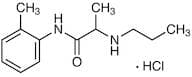
CAS:Formula:C13H20N2O·HClPurity:>98.0%(HPLC)Color and Shape:White to Almost white powder to crystalMolecular weight:256.77PRILOCAINE CRS
CAS:PRILOCAINE CRSFormula:C13H20N2OColor and Shape:Crystalline Powder. White. Powder.Molecular weight:220.3107Prilocaine
CAS:Aromatic cyclic amides (including cyclic carbamates) and their derivatives; salts thereofFormula:C13H20N2OColor and Shape:White Off-White PowderMolecular weight:220.31Propanamide, N-(2-methylphenyl)-2-(propylamino)-
CAS:Formula:C13H20N2OPurity:98%Color and Shape:SolidMolecular weight:220.3107Prilocaine-d7 HCl
CAS:Formula:C13H13D7N2O·HClColor and Shape:White To Off-White SolidMolecular weight:227.36 36.46Prilocaine
CAS:Formula:C13H20N2OPurity:(Titration) ≥ 99.0%Color and Shape:White powderMolecular weight:220.31Prilocaine
CAS:Prilocaine (NSC-40027) is a local anesthetic of the amino amide type, which acts on the sodium channel on the neuronal membrane and limits the spread ofFormula:C13H20N2OPurity:98.49%Color and Shape:Needles SolidMolecular weight:220.31PRILOCAINE
CAS:Formula:C13H20N2OPurity:99%+(HPLC);RGColor and Shape:No data available.Molecular weight:220.316Prilocaine base
CAS:Prilocaine is a local anesthetic that is used to provide relief from pain and discomfort during minor surgery or other procedures. It belongs to the group of amide local anesthetics. Prilocaine has been shown to be effective in treating eye disorders, such as dry eyes, and is able to block transmission of the nerve impulses from the trigeminal nerve. The phase transition temperature for prilocaine is about -10 degrees Celsius. It can be dissolved in water vapor and reacts with analytical reagents such as hydrogen peroxide to produce a blue color. The chemical structure of prilocaine has been analyzed using X-ray crystallography, infrared spectroscopy, and nuclear magnetic resonance spectroscopy.
Formula:C13H20N2OPurity:Min. 95%Color and Shape:White To Off-White SolidMolecular weight:220.31 g/mol