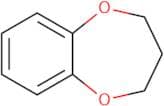
CAS 7216-18-4
:3,4-Dihydro-2H-1,5-benzodioxepin
Description:
3,4-Dihydro-2H-1,5-benzodioxepin, with the CAS number 7216-18-4, is an organic compound characterized by its unique bicyclic structure that incorporates a dioxepin ring fused to a benzene ring. This compound typically exhibits a colorless to pale yellow appearance and is known for its relatively low volatility. It is soluble in organic solvents, such as ethanol and ether, but has limited solubility in water due to its hydrophobic nature. The presence of the dioxepin moiety contributes to its potential reactivity, particularly in electrophilic substitution reactions. Additionally, 3,4-dihydro-2H-1,5-benzodioxepin may exhibit interesting pharmacological properties, making it a subject of interest in medicinal chemistry. Its stability under standard conditions allows for various synthetic applications, although care must be taken to avoid conditions that could lead to degradation. Overall, this compound serves as a valuable building block in organic synthesis and may have implications in the development of new materials or pharmaceuticals.
Formula:C9H10O2
InChI:InChI=1S/C9H10O2/c1-2-5-9-8(4-1)10-6-3-7-11-9/h1-2,4-5H,3,6-7H2
InChI key:InChIKey=CBXMULHQEVXJDI-UHFFFAOYSA-N
SMILES:C=12C(=CC=CC1)OCCCO2
Synonyms:- 1,2-Trimethylenedioxybenzene
- 2H-1,5-Benzodioxepin, 3,4-dihydro-
- 3,4-Dihydro-2H-1,4-benzodioxepin
- 3,4-Dihydro-2H-benzo[b][1,4]dioxepine
- 3,4-dihydro-2H-1,5-benzodioxepine
- Brn 0128377
- Pyrocatechol trimethylene ether
- 5-19-01-00450 (Beilstein Handbook Reference)
- 3,4-Dihydro-2H-1,5-benzodioxepin
Sort by
Purity (%)
0
100
|
0
|
50
|
90
|
95
|
100
Found 4 products.
3,4-Dihydro-2H-benzo[b][1,4]dioxepine
CAS:Formula:C9H10O2Purity:98%Color and Shape:LiquidMolecular weight:150.17453,4-dihydro-2H-1,5-benzodioxepine
CAS:3,4-dihydro-2H-1,5-benzodioxepinePurity:98%Molecular weight:150.17g/mol3,4-dihydro-2H-1,5-benzodioxepine
CAS:3,4-Dihydro-2H-1,5-benzodioxepine is a chalcone that has been shown to have organic and inorganic acid properties. It is a natural product that has been shown to inhibit the growth of bacteria. The ultraviolet absorption properties of 3,4-dihydro-2H-1,5-benzodioxepine are due to its conjugated double bond system. This compound is an amide and contains a hydroxyl group and a chloride ion. 3,4-Dihydro-2H-1,5-benzodioxepine also has the ability to bind with amino groups on proteins. 3,4-Dihydro-2H-1,5 benzodioxepine can be found in plants such as "Achillea millefolium" (Yarrow).Formula:C9H10O2Purity:Min. 95%Molecular weight:150.18 g/mol
![3,4-Dihydro-2H-benzo[b][1,4]dioxepine](/_next/image/?url=https%3A%2Fstatic.cymitquimica.com%2Fproducts%2FIN%2Fthumb%2FDA003IHC.jpg&w=3840&q=75)


![3,4-Dihydro-2H-benzo[b][1,4]dioxepine](/_next/image/?url=https%3A%2Fstatic.cymitquimica.com%2Fproducts%2F10%2Fthumb%2FF219112.jpg&w=3840&q=75)