CAS 72332-33-3
:Procaterol
Description:
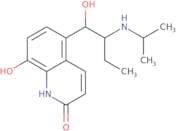
Procaterol is a selective beta-2 adrenergic agonist primarily used as a bronchodilator in the treatment of asthma and chronic obstructive pulmonary disease (COPD). It functions by stimulating beta-2 adrenergic receptors in the smooth muscle of the airways, leading to relaxation and dilation of bronchial passages, which facilitates easier breathing. Procaterol is characterized by its relatively long duration of action, making it suitable for both acute and chronic management of respiratory conditions. The compound is typically administered via inhalation, allowing for targeted delivery to the lungs while minimizing systemic side effects. Its chemical structure includes a phenolic moiety and an aliphatic side chain, contributing to its pharmacological properties. As with other beta-2 agonists, potential side effects may include tremors, palpitations, and increased heart rate, particularly at higher doses. Overall, procaterol represents an important therapeutic option in respiratory medicine, particularly for patients requiring long-term bronchodilation.
Formula:C16H22N2O3
InChI:InChI=1/C16H22N2O3/c1-4-12(17-9(2)3)16(21)11-5-7-13(19)15-10(11)6-8-14(20)18-15/h5-9,12,16-17,19,21H,4H2,1-3H3,(H,18,20)/t12-,16+/s2
InChI key:InChIKey=FKNXQNWAXFXVNW-ZEFNCDPZNA-N
SMILES:[C@H]([C@H](NC(C)C)CC)(O)C1=C2C(=C(O)C=C1)NC(=O)C=C2
Synonyms:- (.+-.)-Procaterol
- (R,S)-Procaterol
- 2(1H)-Quinolinone, 8-hydroxy-5-[1-hydroxy-2-[(1-methylethyl)amino]butyl]-, (R*,S*)-
- rel-8-Hydroxy-5-[(1R,2S)-1-hydroxy-2-[(1-methylethyl)amino]butyl]-2(1H)-quinolinone
- 2(1H)-Quinolinone, 8-hydroxy-5-[(1R,2S)-1-hydroxy-2-[(1-methylethyl)amino]butyl]-, rel-
Sort by
Purity (%)
0
100
|
0
|
50
|
90
|
95
|
100
Found 4 products.
Procaterol
CAS:Procaterol is a bronchodilator, which is a synthetic beta-2 adrenergic agonist. It is derived through chemical processes designed to specifically target the beta-2 adrenergic receptors located in the bronchial smooth muscle. The mode of action involves the activation of these receptors, which leads to the relaxation of bronchial smooth muscles. This relaxation effect facilitates the widening of airways, improving airflow and respiratory function.
Formula:C16H22N2O3Purity:Min. 95%Molecular weight:290.36 g/mol