CAS 727356-19-6
:2-bromo-6-(chloromethyl)pyridine
Description:
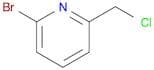
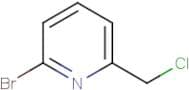
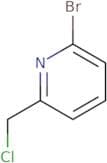
2-Bromo-6-(chloromethyl)pyridine is a heterocyclic organic compound characterized by a pyridine ring substituted with both bromine and chloromethyl groups. The presence of the bromine atom at the 2-position and the chloromethyl group at the 6-position contributes to its reactivity and potential applications in organic synthesis. This compound is typically a colorless to pale yellow liquid or solid, depending on its form and purity. It is soluble in organic solvents, which makes it useful in various chemical reactions, particularly in the synthesis of more complex molecules. The functional groups present in 2-bromo-6-(chloromethyl)pyridine can participate in nucleophilic substitution reactions, making it a valuable intermediate in the production of pharmaceuticals, agrochemicals, and other fine chemicals. Safety precautions should be observed when handling this compound, as both bromine and chlorine are halogens that can pose health risks. Proper storage and disposal methods are essential to mitigate any environmental impact.
Formula:C6H5BrClN
InChI:InChI=1/C6H5BrClN/c7-6-3-1-2-5(4-8)9-6/h1-3H,4H2
SMILES:c1cc(CCl)nc(c1)Br
Synonyms:- Pyridine, 2-Bromo-6-(Chloromethyl)-
Sort by
Purity (%)
0
100
|
0
|
50
|
90
|
95
|
100
Found 4 products.
2-Bromo-6-(chloromethyl)pyridine
CAS:Formula:C6H5BrClNPurity:98%Color and Shape:SolidMolecular weight:206.46762-Bromo-6-(chloromethyl)pyridine
CAS:2-Bromo-6-(chloromethyl)pyridinePurity:97%Molecular weight:206.47g/mol2-Bromo-6-(chloromethyl)pyridine
CAS:2-Bromo-6-(chloromethyl)pyridine is a ligand that binds to transition metal ions. It has been shown to have a high affinity for thionyl, which is an endogenous substrate. The ligand has also been used in the immobilization of biomolecules, such as proteins and DNA. The ligand has been synthesized by reacting cyanuric chloride with 2-bromopyridine. This method is different from the traditional synthetic pathway, which typically involves reacting chloroform with methyl bromide in the presence of a base or acid. The synthesis of this ligand can be done using two methods: (1) reaction of histidine with hydroxylamine hydrochloride and methyl bromide; or (2) reaction of methylamine with ethyl chlorocarbonate and 1,4-diazabicyclo[2.2.2]octane.Formula:C6H5BrClNPurity:Min. 95%Molecular weight:206.47 g/mol