CAS 73058-30-7
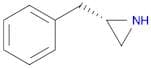
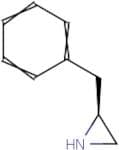
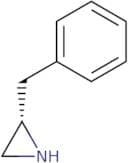
:(S)-2-Benzylaziridine
Description:
(S)-2-Benzylaziridine is a chiral organic compound characterized by its three-membered aziridine ring, which contains a nitrogen atom and is substituted with a benzyl group. This compound is notable for its potential applications in asymmetric synthesis and as an intermediate in the production of various pharmaceuticals and agrochemicals. The presence of the benzyl group enhances its reactivity and solubility in organic solvents. As a chiral molecule, (S)-2-benzylaziridine can exhibit different biological activities compared to its enantiomer, making it of interest in medicinal chemistry. Its structure contributes to its unique properties, including ring strain, which can influence its reactivity in chemical reactions. Additionally, (S)-2-benzylaziridine may participate in nucleophilic substitutions and cycloadditions, further expanding its utility in synthetic organic chemistry. Safety data should be consulted for handling and storage, as with all chemical substances, to ensure proper laboratory practices.
Formula:C9H11N
InChI:InChI=1/C9H11N/c1-2-4-8(5-3-1)6-9-7-10-9/h1-5,9-10H,6-7H2/t9-/m0/s1
SMILES:c1ccc(cc1)C[C@H]1CN1
Synonyms:- (2S)-2-Benzylaziridine
- Aziridine, 2-(phenylmethyl)-, (2S)-
- (S)-2-Benzyl-Aziridine
Sort by
Purity (%)
0
100
|
0
|
50
|
90
|
95
|
100
Found 6 products.
(S)-2-Benzylaziridine
CAS:Controlled ProductApplications (S)-2-Benzylaziridine is a reagent for the synthesis of renin inhibitors, taurine and cannabinoid type 2 (CB2) receptor agonists.
References Kaltenbronn, J. S., et al.: J. Med. Chem 33, 838 (1990); Hu, L., et al.: J. Org. Chem. 72, 4543 (2007); Matsushima, Y., et al.: Jpn. Kokai Tokkyo Koho JP 2012072067 A 20120412 (2012)Formula:C9H11NColor and Shape:NeatMolecular weight:133.19S-Benzyl-aziridine
CAS:Controlled ProductBenzyl aziridine is an organic compound with the formula CH3C(O)NCH2CH2C6H5. It is a chiral molecule that can be used to synthesize optically pure epoxides, amines, and carbonic acids. Benzyl aziridine can also be used as an activating agent for the synthesis of epoxides and amines from alkenes (e.g., propene), alcohols, and ammonia. The reaction usually takes place at room temperature in aqueous media. Mechanistic studies have shown that benzyl aziridine does not activate substrates by reacting with them directly but through its intermediate aziridines or anhydrides.Formula:C9H11NPurity:Min. 95%Molecular weight:133.19 g/mol