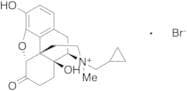
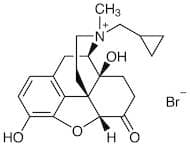
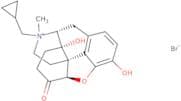
CAS 73232-52-7
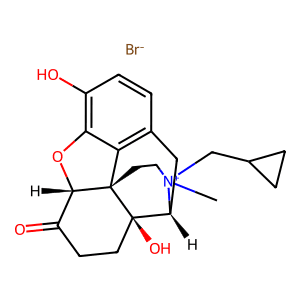
:Methylnaltrexone bromide
- (17RS)-17-(Cyclopropylmethyl)-4,5-alpha-epoxy-3,14-dihydroxy-17-methyl-6- oxomorphinanium bromide
- (5Alpha)-17-(Cyclopropylmethyl)-3,14-Dihydroxy-17-Methyl-4,5-Epoxymorphinan-17-Ium-6-One Bromide
- Methylnaltrexone bromide [USAN]
- Moa-728
- Morphinanium, 17-(cyclopropylmethyl)-4,5-epoxy-3,14-dihydroxy-17-methyl-6-oxo-, bromide (1:1), (5α)-
- Morphinanium, 17-(cyclopropylmethyl)-4,5-epoxy-3,14-dihydroxy-17-methyl-6-oxo-, bromide, (5alpha)-
- Mrz 2663
- Mrz 2663Br
- N-Cyclopropylmethyl-noroxymorphone methobromide
- N-Methylnaltrexone bromide
- Naltrexone methobromide
- Naltrexone methyl bromide
- Relistor
- Unii-Rfo6Il3D3M
- See more synonyms
Methylnaltrexone Bromide
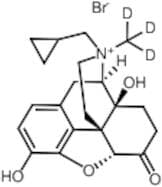
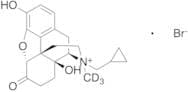
CAS:Alkaloids of opium and their derivatives, salts thereof, not elsewhere specified or includedFormula:C21H26BrNO4Color and Shape:White Off-White PowderMolecular weight:435.10452Methyl Naltrexone-d3 Bromide (Mixture of Diastereomers)
CAS:Formula:C21H23D3NO4·BrMolecular weight:359.46 79.90Methylnaltrexone bromide
CAS:Methylnaltrexone bromide (MOA-728) is one of the newer agents of peripherally-acting μ-opioid antagonists, acts to reverse the side effects of opioid drugs.Formula:C21H26BrNO4Purity:99.02%Color and Shape:SolidMolecular weight:436.35N-Methyl Naltrexone-d3 Bromide
CAS:Controlled ProductApplications A labelled metabolite of Naltrexone (N285750). Methylnaltrexone (MNTX), a selective μ-opioid receptor antagonist, functions as a peripherally acting receptor antagonist in tissues of the gastrointestinal tract.
Not a dangerous good if item is equal to or less than 1g/ml and there is less than 100g/ml in the package
References Wall, M., et al.: Drug Metab. Dispos., 12, 677 (1984), Jones, D., et al.: .: Bioorg. Med. Chem., 13, 6727 ( 2005), Chen, T., et al.: Drugs Future, 32, 771 (2007),Formula:C21H23D3BrNO4Color and Shape:NeatMolecular weight:439.36N-Methyl Naltrexone Bromide
CAS:Controlled ProductStability Hygroscopic
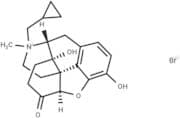
Applications A metabolite of Naltrexone (N285750). Methylnaltrexone (MNTX; M320350), a selective μ-opioid receptor (MOR) antagonist, functions as a peripherally acting receptor antagonist in tissues of the gastrointestinal tract. When opiates activate μ-opioid receptors (MORs) they trigger signaling pathways that lead to tolerance and hyperalgesia. Methylnaltrexone (M320350) is positively charged and therefore does not cross the blood brain barier. Mice given morphine with methylnaltrexone experienced pain relief without degeloping tolerance.
Not a dangerous good if item is equal to or less than 1g/ml and there is less than 100g/ml in the package
References Wall, M., et al.: Drug Metab. Dispos., 12, 677 (1984), Jones, D., et al.: .: Bioorg. Med. Chem., 13, 6727 ( 2005), Chen, T., et al.: Drugs Future, 32, 771 (2007); Chem. and Eng. News p.4 Jan. 23, (2017)Formula:C21H26BrNO4Color and Shape:NeatMolecular weight:436.35Methylnaltrexone Bromide
CAS:Formula:C21H26BrNO4Purity:>95.0%(HPLC)(qNMR)Color and Shape:White to Light yellow powder to crystalMolecular weight:436.35N-Methyl naltrexone bromide
CAS:Controlled ProductN-Methyl naltrexone bromide is an opioid antagonist that binds to opioid receptors, preventing the binding of other opioid agonists. It has been shown to be effective in long-term treatment of chronic pain and may be used in combination with opioids for patients with hepatic impairment. The efficacy of N-methyl naltrexone bromide in treating constipation has not been established. This drug should not be used in patients with HIV infection because it may reduce the effectiveness of antiretroviral therapy. The pharmacokinetics and safety profile of this drug have been studied extensively, which showed no serious adverse effects. Histological analysis revealed that N-methyl naltrexone bromide did not affect epithelial mesenchymal cells or the intestinal villi.
Formula:C21H26BrNO4Purity:Min. 95%Molecular weight:436.34 g/molRef: 3D-FM25532
Discontinued product