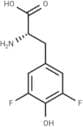
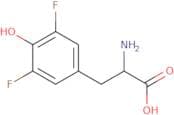
CAS 73246-30-7
:L-Tyrosine,3,5-difluoro-
Description:
L-Tyrosine, 3,5-difluoro- is a fluorinated derivative of the amino acid L-Tyrosine, which is an important building block for proteins and a precursor for neurotransmitters such as dopamine, norepinephrine, and epinephrine. The presence of fluorine atoms at the 3 and 5 positions of the aromatic ring can significantly influence the compound's chemical properties, including its reactivity, solubility, and biological activity. Generally, fluorinated compounds exhibit enhanced metabolic stability and altered pharmacokinetics compared to their non-fluorinated counterparts. L-Tyrosine itself is known for its role in the synthesis of melanin and thyroid hormones, and the introduction of fluorine may affect these pathways. The compound is likely to be a solid at room temperature, with potential applications in pharmaceuticals, biochemistry, and materials science. As with many fluorinated compounds, safety and handling considerations are important due to the potential for toxicity and environmental impact. Further studies would be necessary to fully elucidate its biological effects and potential uses.
Formula:C9H9F2NO3
Synonyms:- 3,5-Difluoro-L-tyrosine
- Benzenepropanoic acid, β-amino-α,α-difluoro-4-hydroxy-, (betaR)-
- (S)-2-amino-3-(3,5-difluoro-4-hydroxyphenyl)propanoic acid
- L-Tyrosine, 3,5-difluoro-
- 2-Amino-3-(3,5-difluoro-4-hydroxyphenyl)propanoicacid
- H-Tyr(3,5-F2)-OH
Sort by
Purity (%)
0
100
|
0
|
50
|
90
|
95
|
100
Found 3 products.
3,5-Difluoro-L-tyrosine
CAS:Formula:C9H9F2NO3Purity:97%Color and Shape:SolidMolecular weight:217.16953,5-Difluoro-L-tyrosine
CAS:3,5-Difluoro-L-tyrosine, a tyrosine analog, resists tyrosinase and tests PTP substrate specificity.Formula:C9H9F2NO3Color and Shape:SolidMolecular weight:217.173,5-Difluoro-L-tyrosine
CAS:3,5-Difluoro-L-tyrosine is a fluorinated amino acid, which is synthesized through chemical modification of L-tyrosine. This compound is a product of organic synthesis processes, typically starting with L-tyrosine, a naturally occurring amino acid, and introducing fluorine atoms at specific positions on the phenyl ring. The introduction of fluorine atoms significantly alters the chemical properties of the tyrosine moiety, allowing it to function as a probe or substitute in various biochemical applications.
Formula:C9H9F2NO3Purity:Min. 95%Molecular weight:217.17 g/mol