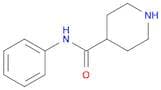
CAS 73415-85-7
:N-Phenyl-4-piperidinecarboxamide
Description:
N-Phenyl-4-piperidinecarboxamide, also known by its CAS number 73415-85-7, is a chemical compound characterized by its piperidine ring structure, which is a six-membered ring containing one nitrogen atom. This compound features a phenyl group attached to the nitrogen of the piperidine, along with a carboxamide functional group. It is typically a white to off-white solid and is soluble in organic solvents. The presence of the piperidine and phenyl groups contributes to its potential biological activity, making it of interest in medicinal chemistry. N-Phenyl-4-piperidinecarboxamide may exhibit properties such as analgesic or anti-inflammatory effects, although specific biological activities can vary based on structural modifications and the context of use. Safety and handling precautions should be observed, as with any chemical substance, due to potential toxicity or reactivity. Overall, this compound serves as a valuable scaffold in drug development and research applications.
Formula:C12H16N2O
InChI:InChI=1S/C12H16N2O/c15-12(10-6-8-13-9-7-10)14-11-4-2-1-3-5-11/h1-5,10,13H,6-9H2,(H,14,15)
InChI key:InChIKey=AKQIYQXGTBXWND-UHFFFAOYSA-N
SMILES:C(NC1=CC=CC=C1)(=O)C2CCNCC2
Synonyms:- 4-(Phenylcarbamoyl)piperidine
- 4-Piperidinecarboxamide, N-phenyl-
- Piperidine-4-carboxylic acid phenylamide
- N-Phenyl-4-piperidinecarboxamide
Sort by
Purity (%)
0
100
|
0
|
50
|
90
|
95
|
100
Found 3 products.
N-Phenylpiperidine-4-carboxamide
CAS:<p>N-Phenylpiperidine-4-carboxamide is a drug that inhibits the production of thromboxane A2 and other substances that promote clotting. It is used to treat patients with high blood pressure, as well as for the prevention of strokes and heart attacks. N-Phenylpiperidine-4-carboxamide is an analog of biphenyl and has been shown to have antiplatelet activity in humans. This drug also inhibits soluble guanylate cyclase, which prevents platelets from sticking together and forming clots. N-Phenylpiperidine-4-carboxamide is rapidly metabolized by esterases in the human body and excreted primarily in urine. The pharmacokinetic properties of this drug are not well understood but it can be synthesized using a number of different methods involving amide bonds.</p>Formula:C12H16N2OPurity:Min. 95%Color and Shape:White PowderMolecular weight:204.27 g/mol