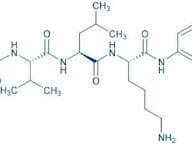
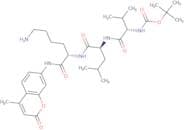
CAS 73554-84-4
:tert-(Butyloxycarbonyl)-L-valyl-L-leucyl-L-lysine-7-amino-4-methylcoumarin
Description:
Tert-(Butyloxycarbonyl)-L-valyl-L-leucyl-L-lysine-7-amino-4-methylcoumarin, commonly referred to as a peptide derivative, is characterized by its complex structure that includes a tert-butyloxycarbonyl (Boc) protecting group, which is often used in peptide synthesis to protect amino groups. The presence of L-valine, L-leucine, and L-lysine indicates that it is a synthetic peptide composed of these amino acids, contributing to its biological activity and potential applications in drug development. The 7-amino-4-methylcoumarin moiety serves as a fluorescent tag, making this compound useful in biochemical assays and studies involving peptide interactions. This compound is typically soluble in organic solvents and may exhibit specific reactivity based on its functional groups. Its stability and reactivity can be influenced by environmental conditions such as pH and temperature. Overall, this substance is significant in the fields of medicinal chemistry and biochemistry, particularly in the development of peptide-based therapeutics and fluorescent probes.
Formula:C32H49N5O7
InChI:InChI=1S/C32H49N5O7/c1-18(2)15-24(36-30(41)27(19(3)4)37-31(42)44-32(6,7)8)29(40)35-23(11-9-10-14-33)28(39)34-21-12-13-22-20(5)16-26(38)43-25(22)17-21/h12-13,16-19,23-24,27H,9-11,14-15,33H2,1-8H3,(H,34,39)(H,35,40)(H,36,41)(H,37,42)/t23-,24-,27-/m0/s1
InChI key:InChIKey=KVLPXRKIIFWZLM-DPZBCOQUSA-N
SMILES:CC=1C=2C(=CC(NC([C@@H](NC([C@@H](NC([C@@H](NC(OC(C)(C)C)=O)[C@@H](C)C)=O)CC(C)C)=O)CCCCN)=O)=CC2)OC(=O)C1
Synonyms:- 7: PN: WO2004106541 PAGE: 15 claimed protein
- <span class="text-smallcaps">L</smallcap>-Lysinamide, N-[(1,1-dimethylethoxy)carbonyl]-<smallcap>L</smallcap>-valyl-<smallcap>L</span>-leucyl-N-(4-methyl-2-oxo-2H-1-benzopyran-7-yl)-
- Boc-Val-Leu-Lys-AMC
- Boc-Val-Leu-Lys-Amc Acetate
- N-(tert-butoxycarbonyl)-L-valyl-L-leucyl-N-(4-methyl-2-oxo-2H-chromen-7-yl)-L-lysinamide
- N-[(1,1-Dimethylethoxy)carbonyl]-<span class="text-smallcaps">L</smallcap>-valyl-<smallcap>L</smallcap>-leucyl-N-(4-methyl-2-oxo-2H-1-benzopyran-7-yl)-<smallcap>L</span>-lysinamide
- tert-(Butyloxycarbonyl)-<span class="text-smallcaps">L</smallcap>-valyl-<smallcap>L</smallcap>-leucyl-<smallcap>L</span>-lysine-7-amino-4-methylcoumarin
- tert-(Butyloxycarbonyl)-L-valyl-L-leucyl-L-lysine-7-amino-4-methylcoumarin
- N-[(1,1-Dimethylethoxy)carbonyl]-L-valyl-L-leucyl-N-(4-methyl-2-oxo-2H-1-benzopyran-7-yl)-L-lysinamide
- L-Lysinamide, N-[(1,1-dimethylethoxy)carbonyl]-L-valyl-L-leucyl-N-(4-methyl-2-oxo-2H-1-benzopyran-7-yl)-
Sort by
Purity (%)
0
100
|
0
|
50
|
90
|
95
|
100
Found 3 products.
Boc-Val-Leu-Lys-AMC
CAS:A sensitive, fluorogenic, and specific substrate for the quantitative measurement of plasmin. Boc-VLK-AMC is also cleaved by acrosin from the ascidian Halocynthia roretzi, by porcine calpain isozymes I and II, and by papain.Formula:C32H49N5O7Purity:97.7%Color and Shape:White LyophilisateMolecular weight:615.77Boc-Val-Leu-Lys-AMC
CAS:Boc-Val-Leu-Lys-AMC is a research tool that has been shown to activate ion channels and increase the permeability of cell membranes. This compound also binds to receptors on cells, which may be due to its ability to bind with antibodies. Boc-Val-Leu-Lys-AMC has been used as an inhibitor in protein interactions and pharmacology studies, as well as for the study of ion channels in cell biology.Formula:C32H49N5O7Purity:Min. 95%Molecular weight:615.76 g/molBoc-Val-Leu-Lys-AMC acetate salt
CAS:Boc-Val-Leu-Lys-AMC acetate salt is a protease inhibitor that binds to the active site of trypsin and inhibits its proteolytic activity. It has been shown to protect neuronal cells from death caused by amyloid beta (Aβ) peptide. Boc-Val-Leu-Lys-AMC acetate salt also inhibits the secretion of proinflammatory cytokines and reduces the permeability of mitochondrial membranes in human neutrophils. This drug is stable in acidic environments, with a pH optimum of 2.0, but is sensitive to alkaline conditions with a pH optimum of 8.5. Boc-Val-Leu-Lys-AMC acetate salt has been shown to bind to casein, which may result in high values on sephadex g100 chromatography.Formula:C32H49N5O7•C2H4O2Purity:Min. 98 Area-%Color and Shape:PowderMolecular weight:675.81 g/mol