![5-[(2-methylacryloyl)amino]benzene-1,3-dicarboxylic acid](/_next/image/?url=https%3A%2Fstatic.cymitquimica.com%2Fcas-image%2Fthumb-webp%2F261931-5-2-methylacryloyl-amino-benzene-13-dicarboxylic-acid.webp&w=3840&q=75)
CAS 73912-52-4
:5-[(2-methylacryloyl)amino]benzene-1,3-dicarboxylic acid
Description:
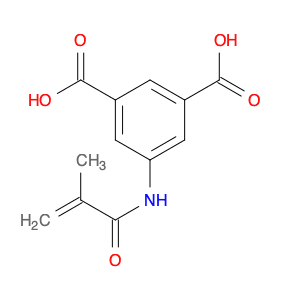
5-[(2-Methylacryloyl)amino]benzene-1,3-dicarboxylic acid, with the CAS number 73912-52-4, is an organic compound characterized by its aromatic structure and the presence of multiple functional groups. It features a benzene ring substituted with two carboxylic acid groups and an amino group linked to a 2-methylacryloyl moiety. This compound exhibits both acidic and basic properties due to the carboxylic acid and amino functionalities, allowing it to participate in various chemical reactions, such as esterification and amidation. The presence of the 2-methylacryloyl group suggests potential for polymerization, making it of interest in materials science and organic synthesis. Additionally, the compound may exhibit biological activity, which could be explored for pharmaceutical applications. Its solubility and reactivity can vary depending on the pH and solvent used, influencing its practical applications in research and industry. Overall, this compound's unique structure and functional groups make it a versatile candidate for further study in various chemical contexts.
Formula:C12H11NO5
InChI:InChI=1/C12H11NO5/c1-6(2)10(14)13-9-4-7(11(15)16)3-8(5-9)12(17)18/h3-5H,1H2,2H3,(H,13,14)(H,15,16)(H,17,18)
SMILES:C=C(C)C(=Nc1cc(cc(c1)C(=O)O)C(=O)O)O
Sort by
Purity (%)
0
100
|
0
|
50
|
90
|
95
|
100
Found 4 products.
5-(Methacryloylamino)isophthalic acid
CAS:Formula:C12H11NO5Purity:98%Color and Shape:SolidMolecular weight:249.2194MS 15203
CAS:MS 15203 is a GPR171 agonist that reduces chronic neuropathic and inflammatory pain in male mice.Formula:C12H11NO5Purity:99.53%Color and Shape:SolidMolecular weight:249.22Ref: TM-T37131
2mg43.00€5mg63.00€10mg99.00€25mg200.00€50mg295.00€100mg442.00€500mg964.00€1mL*10mM (DMSO)71.00€MS 15203
CAS:MS 15203 is a specialized biochemical reagent, which is a synthetically derived compound with a high degree of purity suitable for laboratory applications. This product functions primarily through specific interactions with biological molecules, allowing it to facilitate precise biochemical reactions or analyses. Its molecular design provides consistency in performance, making it a reliable component in various experimental protocols.Formula:C12H11NO5Purity:Min. 95%Molecular weight:249.22 g/mol