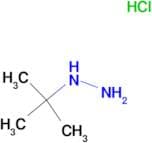
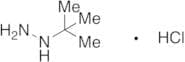
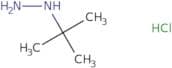
CAS 7400-27-3
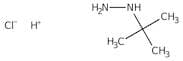
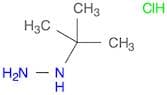
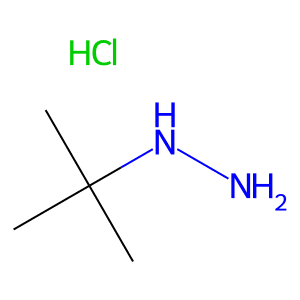
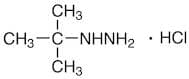
:Hydrazine, (1,1-dimethylethyl)-, hydrochloride (1:1)
Description:
Hydrazine, (1,1-dimethylethyl)-, hydrochloride (1:1), commonly referred to as a hydrazine derivative, is a chemical compound characterized by its hydrazine functional group combined with a tert-butyl group. It appears as a white crystalline solid and is typically soluble in water and various organic solvents. This compound is known for its reactivity, particularly as a reducing agent in various chemical reactions. It may also exhibit properties typical of hydrazine derivatives, such as potential toxicity and the ability to form explosive mixtures under certain conditions. The hydrochloride form indicates that it is a salt formed with hydrochloric acid, which can enhance its stability and solubility. Safety precautions are essential when handling this compound due to its potential health hazards, including skin and respiratory irritation. Additionally, it is important to store it in a cool, dry place away from incompatible substances. Overall, this compound is utilized in specialized applications, including pharmaceuticals and chemical synthesis, but requires careful handling due to its reactive nature.
Formula:C4H12N2·ClH
InChI:InChI=1S/C4H12N2.ClH/c1-4(2,3)6-5;/h6H,5H2,1-3H3;1H
InChI key:InChIKey=DDPWVABNMBRBFI-UHFFFAOYSA-N
SMILES:C(NN)(C)(C)C.Cl
Synonyms:- (1,1-Dimethylethyl)hydrazine hydrochloride
- Butylhydrazinehydrochloride
- Hydrazine, (1,1-dimethylethyl)-, hydrochloride (1:1)
- Hydrazine, (1,1-dimethylethyl)-, monohydrochloride
- Hydrazine, tert-butyl-, hydrochloride
- Hydrazine, tert-butyl-, monohydrochloride
- N-tert-Butyl hydrazine hydrochloride
- N′-tert-Butylhydrazine hydrochloride
- T-Butylhydrazine HCL
- Tert-Butyldiazanediium
- Tert-Butylhydrazine
- Tert-Butylhydrazine Hydrochloride (1:1)
- t-Butylhydrazine hydrochloride
- tert-Butylhydrazine monohydrochloride
- See more synonyms
Sort by
Purity (%)
0
100
|
0
|
50
|
90
|
95
|
100
Found 7 products.
tert-Butylhydrazine hydrochloride, 98%
CAS:It is used in organic synthesis for aromatic nucleophilic N-N exchange reaction. tert-Butylhydrazine Hydrochloride is also used in the preparation of insect growth regulator. tert-Butylhydrazine hydrochloride was used in the synthesis of diphosphinohydrazines, 5-amino-1-tert-butyl-3-(p-chlorophenyl)Formula:(CH3)3CNHNH2•HClPurity:98%Color and Shape:White to pale cream, Crystalline powder or crystalsMolecular weight:124.61tert-Butylhydrazine HCl
CAS:Formula:C4H13ClN2Purity:97%Color and Shape:SolidMolecular weight:124.6124Ref: IN-DA003ULT
1kg64.00€25g21.00€50g24.00€5kg211.00€100g25.00€10kg285.00€250g34.00€500g47.00€100kgTo inquire1-(tert-Butyl)hydrazine hydrochloride
CAS:1-(tert-Butyl)hydrazine hydrochlorideFormula:C4H12N2·ClHPurity:≥95%Color and Shape: white crystalline powderMolecular weight:124.61g/moltert-Butylhydrazine Hydrochloride
CAS:Formula:C4H12N2·HClPurity:>98.0%(T)Color and Shape:White to Almost white powder to lumpMolecular weight:124.61tert-Butylhydrazine hydrochloride
CAS:Formula:C4H13ClN2Purity:97%Color and Shape:Solid, Crystalline PowderMolecular weight:124.61tert-Butylhydrazine Hydrochloride
CAS:Controlled ProductApplications tert-Butylhydrazine Hydrochloride is a a hydrazine compound used in organic synthesis for aromatic nucleophilic N-N exchange reaction. tert-Butylhydrazine Hydrochloride is also used in the preparation of insect growth regulator.
References Hojo, M. et al.: Synthesis, 6, 481 (1990); Zhang, J. et al.: Huax. Shijie, 36, 576 (1995);Formula:C4H13ClN2Color and Shape:NeatMolecular weight:124.611-(tert-Butyl)hydrazine hydrochloride
CAS:1-(tert-Butyl)hydrazine hydrochloride is a chemical with the molecular formula CHN. It is a white solid that is soluble in water, acetone, and ethanol. 1-(tert-Butyl)hydrazine hydrochloride reacts with trifluoroacetic acid to produce methyl ethyl amines. The compound has been shown to be effective in wastewater treatment. 1-(tert-Butyl)hydrazine hydrochloride will react with an amine to form a regiospecific unsymmetrical pyrazole. This reaction takes place in the presence of hydrochloric acid and produces nitrogen gas as a byproduct.Formula:C4H12N2·HClPurity:Min. 95%Molecular weight:124.61 g/mol