CAS 7400-54-6
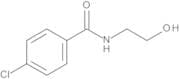
:4-chloro-N-(2-hydroxyethyl)benzamide
Description:
4-Chloro-N-(2-hydroxyethyl)benzamide is an organic compound characterized by its aromatic structure, which includes a benzamide moiety substituted with a chloro group and a hydroxyethyl group. The presence of the chloro substituent introduces a halogen, which can influence the compound's reactivity and solubility. The hydroxyethyl group contributes to the compound's polar characteristics, enhancing its solubility in polar solvents. This compound is typically used in various chemical syntheses and may serve as an intermediate in the production of pharmaceuticals or agrochemicals. Its molecular structure suggests potential hydrogen bonding capabilities due to the hydroxyl group, which can affect its physical properties, such as melting and boiling points. Additionally, the compound may exhibit biological activity, making it of interest in medicinal chemistry. Safety data should be consulted for handling and storage, as the presence of chlorine can pose certain hazards. Overall, 4-chloro-N-(2-hydroxyethyl)benzamide is a versatile compound with applications in both research and industry.
Formula:C9H10ClNO2
InChI:InChI=1/C9H10ClNO2/c10-8-3-1-7(2-4-8)9(13)11-5-6-12/h1-4,12H,5-6H2,(H,11,13)
SMILES:c1cc(ccc1C(=O)NCCO)Cl
Sort by
Purity (%)
0
100
|
0
|
50
|
90
|
95
|
100
Found 6 products.
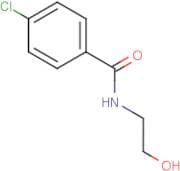
4-Chloro-N-(2-hydroxyethyl)benzamide
CAS:Controlled ProductFormula:C9H10ClNO2Color and Shape:NeatMolecular weight:199.634-Chloro-N-(2-hydroxyethyl)benzamide
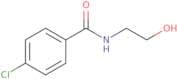
CAS:4-Chloro-N-(2-hydroxyethyl)benzamidePurity:95%Molecular weight:199.63g/mol4-Chloro-N-(2-hydroxyethyl)benzamide
CAS:Formula:C9H10ClNO2Color and Shape:NeatMolecular weight:199.634-Chloro-N-(2-hydroxyethyl)benzamide
CAS:4-Chloro-N-(2-hydroxyethyl)benzamide (4CBEA) is a dopamine uptake inhibitor that has been shown to inhibit the uptake of noradrenaline. It also inhibits apoptotic cell death in human liver cells, which may be due to its ability to induce cell cycle arrest and apoptosis. 4CBEA has been shown to have clinical efficacy in patients with Parkinson's disease, although it should not be used in conjunction with levodopa or other drugs that act on dopaminergic neurons. The affinity of 4CBEA for dopamine uptake sites is weaker than its affinity for noradrenaline uptake sites. It has been shown that 4CBEA binds to the amide group of proteins such as flavin adenine dinucleotide (FAD) and water molecule. Oxidases are enzymes that catalyze the oxidation of organic molecules and can lead to a decrease in the activity of 4CBEA, but thisFormula:C9H10ClNO2Purity:Min. 95%Molecular weight:199.63 g/mol