CAS 74246-64-3
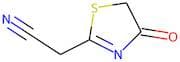
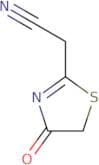
:1,3-Thiazolin-4-one-2-acetonitrile
Description:
1,3-Thiazolin-4-one-2-acetonitrile, with the CAS number 74246-64-3, is a heterocyclic compound featuring a thiazole ring structure. This compound typically exhibits characteristics common to thiazolinones, such as being a potential precursor in organic synthesis and possessing biological activity. It is characterized by the presence of a thiazole ring fused with a carbonyl group and an acetonitrile moiety, which may contribute to its reactivity and solubility in polar solvents. The compound may display moderate to high stability under standard conditions, but its reactivity can vary depending on the presence of functional groups and the reaction environment. Additionally, it may have applications in pharmaceuticals, agrochemicals, or as an intermediate in the synthesis of more complex molecules. Safety data should be consulted for handling and storage, as with any chemical substance, to ensure proper precautions are taken due to potential toxicity or reactivity.
Formula:C5H4N2OS
InChI:InChI=1/C5H4N2OS/c6-2-1-5-7-4(8)3-9-5/h1,3H2
SMILES:C(C#N)C1=NC(=O)CS1
Synonyms:- 2-(4-Oxo-4,5-dihydro-1,3-thiazol-2-yl)acetonitrile
- (4-Oxo-4,5-Dihydro-1,3-Thiazol-2-Yl)Acetonitrile
Sort by
Purity (%)
0
100
|
0
|
50
|
90
|
95
|
100
Found 3 products.
1,3-Thiazolin-4-one-2-acetonitrile
CAS:Formula:C5H4N2OSPurity:95.0%Color and Shape:SolidMolecular weight:140.16(4,5-Dihydro-4-oxo-1,3-thiazol-2-yl)acetonitrile
CAS:(4,5-Dihydro-4-oxo-1,3-thiazol-2-yl)acetonitrileFormula:C5H4N2OSPurity:96%Color and Shape: beige solidMolecular weight:140.16g/mol1,3-Thiazolin-4-one-2-acetonitrile
CAS:1,3-Thiazolin-4-one-2-acetonitrile is a nitrogenous heterocyclic compound with a benzene ring. It is synthesized by refluxing a mixture of thiazolo and triethyl orthoformate in the presence of naphthyridine. The hydrazone and salicylaldehyde are then condensed to form the desired product. This reaction is catalyzed by chromium oxide or potassium permanganate. 1,3-Thiazolin-4-one-2-acetonitrile has been used as an intermediate for the synthesis of other compounds with antihistamine properties such as piperidine and benzene, which have been shown to inhibit the growth of organisms such as Staphylococcus aureus, Klebsiella pneumoniae, Pseudomonas aeruginosa, and Proteus vulgaris.Formula:C5H4N2OSPurity:Min. 95%Color and Shape:PowderMolecular weight:140.16 g/mol