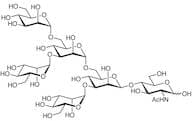
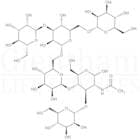
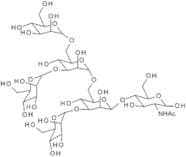
![D-Glucose, O-a-D-mannopyranosyl-(1®3)-O-[O-a-D-mannopyranosyl-(1®3)-O-[a-D-mannopyranosyl-(1®6)]-a…](/_next/image/?url=https%3A%2Fstatic.cymitquimica.com%2Fcas-image%2Fthumb-webp%2F352543-d-glucose-o-a-d-mannopyranosyl-1-r-3-o-o-a-d-mannopyranosyl-1-r-3-o-a-d-mannopyranosyl-1-r-6-a-d-mannopyranosyl-1-r-6-o-b-d-mannopyranosyl-1-r-4-2-acetylamino-2-deoxy.webp&w=3840&q=75)
CAS 74385-50-5
:D-Glucose, O-a-D-mannopyranosyl-(1®3)-O-[O-a-D-mannopyranosyl-(1®3)-O-[a-D-mannopyranosyl-(1®6)]-a-D-mannopyranosyl-(1®6)]-O-b-D-mannopyranosyl-(1®4)-2-(acetylamino)-2-deoxy-
Description:
The chemical substance you are referring to is a complex carbohydrate, specifically a glycoside, derived from D-glucose and D-mannose. It features multiple glycosidic linkages, indicating a branched structure that includes both α- and β-anomeric forms. The presence of acetylamino groups suggests that it may have biological significance, potentially serving as a substrate or inhibitor in enzymatic reactions. This compound is likely soluble in water due to its multiple hydroxyl groups, which can form hydrogen bonds. Its structural complexity may contribute to specific interactions with biological macromolecules, such as proteins or nucleic acids, influencing its role in biological systems. Additionally, the presence of multiple sugar units indicates that it may be involved in cellular recognition processes or serve as a storage form of energy. Overall, this substance exemplifies the intricate nature of polysaccharides and their derivatives in biochemistry.
Formula:C38H65NO31
Synonyms:- Man5Glcnac
Sort by
Purity (%)
0
100
|
0
|
50
|
90
|
95
|
100
Found 3 products.
Man5GlcNAc
CAS:Man5GlcNAc is a glycoprotein that is expressed in the Golgi apparatus of mammalian cells. It is cleaved by alpha-mannosidase II and alpha-mannosidase I, which are enzymes located in the golgi apparatus. Man5GlcNAc has been shown to be an effective glp-1 analogue, which is a hormone that stimulates insulin secretion. This protein has also been shown to have structural similarities to high mannose type oligosaccharides, which are found on the surface of some bacteria. The protein may also act as a signal peptide for proteins that are exported from the golgi to the cell membrane.Formula:C38H65NO31Purity:Min. 95%Color and Shape:PowderMolecular weight:1,031.91 g/mol