CAS 74553-29-0
:2,5-Dibromobenzaldehyde
Description:
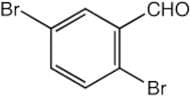
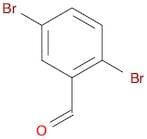
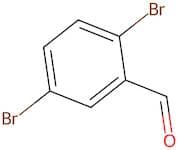
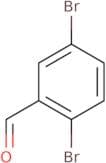
2,5-Dibromobenzaldehyde is an organic compound characterized by the presence of two bromine atoms and an aldehyde functional group attached to a benzene ring. Its molecular structure features a benzaldehyde moiety, where the aldehyde (-CHO) group is located at one end of the aromatic ring. The bromine substituents are positioned at the 2 and 5 carbon atoms of the benzene ring, which influences the compound's reactivity and physical properties. This compound typically appears as a pale yellow to brown solid and is sparingly soluble in water but more soluble in organic solvents such as ethanol and dichloromethane. 2,5-Dibromobenzaldehyde is used in organic synthesis, particularly in the preparation of various pharmaceuticals and agrochemicals. Its bromine substituents can participate in electrophilic aromatic substitution reactions, making it a valuable intermediate in chemical synthesis. Additionally, the presence of the aldehyde group allows for further functionalization, expanding its utility in various chemical applications. Safety precautions should be taken when handling this compound, as it may pose health risks.
Formula:C7H4Br2O
InChI:InChI=1/C7H4Br2O/c8-6-1-2-7(9)5(3-6)4-10/h1-4H
SMILES:c1cc(c(cc1Br)C=O)Br
Synonyms:- Benzaldehyde, 2,5-dibromo-
- Vhr Be Ee
- 2,5-Dibromobenzaldehyde
Sort by
Purity (%)
0
100
|
0
|
50
|
90
|
95
|
100
Found 5 products.
2,5-Dibromobenzaldehyde, 97%
CAS:2,5-Dibromobenzaldehyde is used as intermediate, it is used to produce other chemicals, it can react with Ethane-1,2-diol to get 2-(2,5-Dibromo-phenyl)-[1,3]dioxolane. The reaction occurs with reagent p-toluenesulfonic acid, solvent toluene. This Thermo Scientific Chemicals brand product was origina
Formula:C7H4Br2OPurity:97%Color and Shape:White, PowderMolecular weight:263.922,5-Dibromobenzaldehyde
CAS:2,5-DibromobenzaldehydeFormula:C7H4Br2OPurity:≥95%Color and Shape: white powderMolecular weight:263.91g/mol2,5-Dibromobenzaldehyde
CAS:2,5-Dibromobenzaldehyde is a synthetic compound that has been shown to have a red fluorescent emission. It is also thermally stable and can be used in the synthesis of quinoline derivatives. 2,5-Dibromobenzaldehyde may be used as a potential fluorescent label for viologen or amines. This compound can undergo an intermolecular Diels-Alder reaction with diacetate to form a bicyclic system, which is important to the understanding of its interactions with other compounds.Formula:C7H4Br2OPurity:Min. 95%Color and Shape:PowderMolecular weight:263.91 g/mol