CAS 7479-20-1
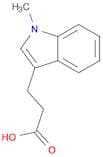
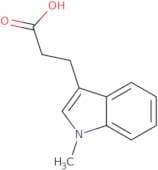
:3-(1-methyl-1H-indol-3-yl)propanoic acid
Description:
3-(1-Methyl-1H-indol-3-yl)propanoic acid, also known by its CAS number 7479-20-1, is an organic compound characterized by its indole structure, which is a bicyclic compound consisting of a benzene ring fused to a pyrrole ring. This substance features a propanoic acid functional group, contributing to its acidic properties. The presence of the methyl group at the 1-position of the indole ring influences its biological activity and solubility. Typically, compounds like this may exhibit various pharmacological properties, making them of interest in medicinal chemistry. The compound is likely to be soluble in organic solvents and may have limited solubility in water due to its hydrophobic indole moiety. Its structural characteristics suggest potential interactions with biological systems, which could be explored for therapeutic applications. However, specific reactivity, stability, and safety profiles would depend on experimental conditions and should be evaluated in a laboratory setting.
Formula:C12H13NO2
InChI:InChI=1/C12H13NO2/c1-13-8-9(6-7-12(14)15)10-4-2-3-5-11(10)13/h2-5,8H,6-7H2,1H3,(H,14,15)
SMILES:Cn1cc(CCC(=O)O)c2ccccc12
Sort by
Purity (%)
0
100
|
0
|
50
|
90
|
95
|
100
Found 3 products.
3-(1-Methyl-1H-indol-3-yl)-propionic acid
CAS:Formula:C12H13NO2Color and Shape:SolidMolecular weight:203.2413-(1-Methyl-1H-indol-3-yl)propanoic acid
CAS:Controlled Product3-(1-Methyl-1H-indol-3-yl)propanoic acid is a potent inhibitor of serine protease. It has been shown to have no effect on fetal heart rate, but can cause bladder cancer in transgenic animals. 3-(1-Methyl-1H-indol-3-yl)propanoic acid blocks the interaction between mammalian cells and bladder cancer cells, which may be due to its ability to block the activation of serine protease in response to thymidylate. This compound also inhibits DNA synthesis and cell growth. It is highly toxic for tumor cells and normal cells, but less so for normal tissues. It also modifies the regulatory domain of cancer cells, making it possible for 3-(1-Methyl-1H-indol-3-yl)propanoic acid to modify cancer cell activity by configuring it with a different regulatory domain that regulates the expression of proteins involved in cancer development.Formula:C12H13NO2Purity:Min. 95%Molecular weight:203.24 g/mol