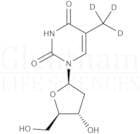
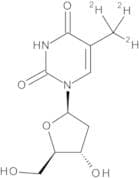
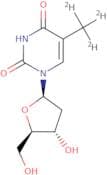
![1-[(2R,4R,5R)-4-hydroxy-5-(hydroxymethyl)tetrahydrofuran-2-yl]-5-(trideuteriomethyl)pyrimidine-2,4…](/_next/image/?url=https%3A%2Fstatic.cymitquimica.com%2Fcas-image%2Fthumb-webp%2F318855-1-2r-4r-5r-4-hydroxy-5-hydroxymethyl-tetrahydrofuran-2-yl-5-trideuteriomethyl-pyrimidine-24-dione.webp&w=3840&q=75)
CAS 74848-84-3
:1-[(2R,4R,5R)-4-hydroxy-5-(hydroxymethyl)tetrahydrofuran-2-yl]-5-(trideuteriomethyl)pyrimidine-2,4-dione
Description:
The chemical substance known as 1-[(2R,4R,5R)-4-hydroxy-5-(hydroxymethyl)tetrahydrofuran-2-yl]-5-(trideuteriomethyl)pyrimidine-2,4-dione, with the CAS number 74848-84-3, is a complex organic compound featuring both a pyrimidine and a tetrahydrofuran moiety. This compound is characterized by its specific stereochemistry, indicated by the (2R,4R,5R) configuration, which plays a crucial role in its biological activity and interactions. The presence of hydroxyl groups contributes to its potential solubility in polar solvents and may influence its reactivity and stability. The incorporation of trideuteriomethyl groups suggests isotopic labeling, which can be useful in studies involving metabolic pathways or mechanistic investigations. Overall, this compound may exhibit interesting pharmacological properties, making it a subject of interest in medicinal chemistry and drug development. Its unique structural features and isotopic composition could also facilitate research in various fields, including biochemistry and molecular biology.
Formula:C10H11D3N2O5
InChI:InChI=1/C10H14N2O5/c1-5-3-12(10(16)11-9(5)15)8-2-6(14)7(4-13)17-8/h3,6-8,13-14H,2,4H2,1H3,(H,11,15,16)/t6-,7-,8-/m1/s1/i1D3
SMILES:C(c1cn([C@H]2C[C@H]([C@@H](CO)O2)O)c(=O)nc1O)([2H])([2H])[2H]
Sort by
Purity (%)
0
100
|
0
|
50
|
90
|
95
|
100
Found 3 products.
Thymidine-d3
CAS:Controlled ProductStability Hygroscopic
Applications Constituent of deoxyribonucleic acid.
References Levene, L., et al.: J. Bil. Chem. 83, 793 (1929), Tollin, et al.: Nature 217, 1148 (1968), Redzic, Z., et al.: Neurochem. Res., 34, 566 (2009), Hazra, S., et al.: Biochem., 48, 1256 (2009), Yang, I., et al.: J. Biol. Chem., 284, 191 (2009),Formula:C102H3H11N2O5Color and Shape:NeatMolecular weight:245.25D3-Thymidine
CAS:Controlled ProductD3-Thymidine is a substance that is formed from the monosaccharide galactose and has been used in biochemical studies. D3-Thymidine has been used as a marker for the damaged DNA of viruses, such as herpes simplex virus type 1, and for the DNA of tumor cells. It has also been used to study the effects of protonation on its function. D3-Thymidine is an unlabeled thymidine derivative that was studied using dichroism spectroscopy. This technique showed that this molecule can exist either in a single form or in two forms with different shapes, depending on its microenvironment. D 3 -thymidine was first synthesized by Dr. Gertrude Buechner at the University of Wisconsin–Madison in 1957. In her experiments, she found that this molecule could be produced by hydrolyzing 2-deoxy-D-ribose with 3 molar equivalents of ammonFormula:C10H11N2O5D3Purity:Min. 95%Color and Shape:PowderMolecular weight:245.25 g/mol