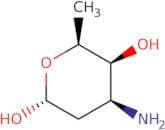
CAS 749168-24-9
:a-L-lyxo-Hexopyranose,3-amino-2,3,6-trideoxy-
Description:
α-L-Lyxo-Hexopyranose, 3-amino-2,3,6-trideoxy- is a sugar derivative characterized by its unique structural features. It is a hexopyranose, meaning it is a six-membered cyclic sugar with a pyranose ring structure. The presence of the amino group at the C-3 position indicates that it is an amino sugar, which can play significant roles in biological processes and may be involved in the formation of glycoproteins and glycolipids. The "2,3,6-trideoxy" designation suggests that this compound lacks hydroxyl groups at the C-2, C-3, and C-6 positions, which distinguishes it from other hexoses and contributes to its reactivity and solubility properties. This compound may exhibit specific stereochemistry, influencing its interactions with enzymes and receptors. Its CAS number, 749168-24-9, allows for precise identification in chemical databases, facilitating research and application in fields such as biochemistry and medicinal chemistry. Overall, this compound's unique structure and functional groups make it of interest for various scientific investigations.
Formula:C6H13NO3
Synonyms:- alpha-L-lyxo-Hexopyranose, 3-amino-2,3,6-trideoxy- (9CI)
Sort by
Purity (%)
0
100
|
0
|
50
|
90
|
95
|
100
Found 1 products.
L-Daunosamine
CAS:L-Daunosamine is a natural amino sugar that is synthesized from D-glucose by the enzyme daunosamine synthetase. L-Daunosamine is a nucleophilic compound that can form an enolate intermediate as well as an amide, which are reactive intermediates in organic synthesis. This compound is also able to undergo stereoselective reactions. The product of this reaction can be used to produce methyl glycosides, which have been shown to have anticancer properties. L-Daunosamine has been shown to be a substrate for the formation of enolates and amides, which are reactive compounds in organic synthesis. This compound has also been shown to undergo stereoselective reactions. The product of this reaction can be used to produce methyl glycosides, which have been shown to have anticancer properties.Formula:C6H11NO3Purity:Min. 95%Molecular weight:145.16 g/mol