CAS 749920-54-5
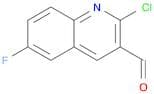
:2-chloro-6-fluoroquinoline-3-carbaldehyde
Description:
2-Chloro-6-fluoroquinoline-3-carbaldehyde is a chemical compound belonging to the quinoline family, characterized by a fused bicyclic structure containing a nitrogen atom. This compound features a chloro group at the 2-position and a fluoro group at the 6-position of the quinoline ring, along with an aldehyde functional group at the 3-position. The presence of these substituents contributes to its unique reactivity and potential applications in medicinal chemistry, particularly in the development of pharmaceuticals. The compound is typically a solid at room temperature and may exhibit moderate solubility in organic solvents. Its molecular structure allows for various chemical reactions, including nucleophilic additions and substitutions, making it a valuable intermediate in organic synthesis. Additionally, the presence of halogen atoms can influence its biological activity, potentially enhancing its efficacy against certain targets. As with many chemical substances, safety precautions should be observed when handling this compound due to its potential toxicity and reactivity.
Formula:C10H5ClFNO
InChI:InChI=1/C10H5ClFNO/c11-10-7(5-14)3-6-4-8(12)1-2-9(6)13-10/h1-5H
SMILES:c1cc2c(cc(C=O)c(Cl)n2)cc1F
Synonyms:- 3-Quinolinecarboxaldehyde, 2-Chloro-6-Fluoro-
- 2-Chloro-6-fluoroquinoline-3-carbaldehyde
Sort by
Purity (%)
0
100
|
0
|
50
|
90
|
95
|
100
Found 4 products.
2-Chloro-6-fluoroquinoline-3-carboxaldehyde
CAS:Formula:C10H5ClFNOPurity:95%Color and Shape:SolidMolecular weight:209.60422-Chloro-6-fluoroquinoline-3-carboxaldehyde
CAS:2-Chloro-6-fluoroquinoline-3-carboxaldehydePurity:95%Molecular weight:209.60g/mol2-Chloro-6-fluoroquinoline-3-carboxaldehyde
CAS:2-Chloro-6-fluoroquinoline-3-carboxaldehyde is a potent inhibitor used in various research applications. It is commonly used in the synthesis of amide derivatives and xylose-based compounds. This compound is widely used in the field of Research Chemicals and has shown promising results in studies related to icosapent ethyl, hydrogen bonding, hydrobromide, biomass, chromobacterium, fatty acid metabolism, potassium channels, triclosan resistance, deoxyviolacein production, methanol utilization, and fluralaner synthesis. Its versatile nature makes it an essential component for researchers looking to explore these areas of study.Formula:C10H5ClFNOPurity:Min. 95%Molecular weight:209.6 g/mol