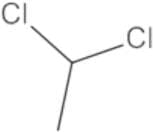
CAS 75-34-3
:1,1-Dichloroethane
Description:
1,1-Dichloroethane, with the CAS number 75-34-3, is a colorless, volatile liquid that is classified as a chlorinated hydrocarbon. It has a sweet odor and is primarily used as a solvent in various industrial applications, including the production of adhesives, coatings, and other chemical processes. The molecular formula of 1,1-dichloroethane is C2H4Cl2, indicating that it contains two carbon atoms, four hydrogen atoms, and two chlorine atoms. It is relatively stable under normal conditions but can undergo reactions such as hydrolysis and photodegradation. The substance has a moderate boiling point and is soluble in organic solvents while being less soluble in water. Due to its chemical structure, 1,1-dichloroethane can pose health risks, including potential neurotoxicity and respiratory irritation upon exposure. Therefore, proper handling and safety measures are essential when working with this compound in laboratory or industrial settings.
Formula:C2H4Cl2
InChI:InChI=1S/C2H4Cl2/c1-2(3)4/h2H,1H3
InChI key:InChIKey=SCYULBFZEHDVBN-UHFFFAOYSA-N
SMILES:C(C)(Cl)Cl
Synonyms:- 1,1-Dichloraethan
- 1,1-Dichlorethan
- 1,1-Dichloroethane
- 1,1-Dicloroetano
- 1,1-Ethylene dichloride
- Dichloromethylmethane
- Ethylene DI-Chloride
- Ethylidene Chloride
- Ethylidene dichloride
- F 150a
- HCC 150a
- 1,1-Dichloroethane (1mg/ml in methanol)
- Ethane, 1,1-dichloro-
- See more synonyms
Sort by
Purity (%)
0
100
|
0
|
50
|
90
|
95
|
100
1,1-Dichloroethane (Stabilized with Nitromethane, ~0.5%) (>90%)
CAS:Controlled Product<p>Stability Very Volatile<br>Applications 1,1-Dichloroethane is used as a chemical solvent in the preparation of precursors of quinolizine, isoquinoline and indole alkaloids(1). Groundwater contaminant, DDT biodegredation product(2,3). Drinking water contaminant candidate list 3 (CCL 3) compound as per United States Environmental Protection Agency (EPA). Environmental contaminants; Food contaminants.<br> Not a dangerous good if item is equal to or less than 1g/ml and there is less than 100g/ml in the package<br>References 1. Butler, E. et al.: Env. Sci. Tech. 2000, 34 (3), pp 422–429.2. Ren, L. et al.: Chemosphere. 2017 Feb;168:244-253.3. Grewal, J. et al.: J. Environ. Sci. Health. B. 2016 Dec;51(12):809-816.<br></p>Formula:C2H4Cl2Purity:>90%Color and Shape:NeatMolecular weight:98.96EPA Method 8010 VOC Mixture 441 200 µg/mL in Methanol
CAS:Controlled Product- 100-44-7
- 10061-01-5
- 10061-02-6
- 106-46-7
- 107-06-2
- 108-86-1
- 108-90-7
- 124-48-1
- 127-18-4
- 156-60-5
- 541-73-1
- 56-23-5
- 630-20-6
- 67-66-3
- 71-55-6
- 74-83-9
- 74-87-3
- 74-95-3
- 75-00-3
- 75-01-4
- 75-09-2
- 75-25-2
- 75-27-4
- 75-34-3
- 75-35-4
- 75-69-4
- 75-71-8
- 78-87-5
- 79-00-5
- 79-01-6
- 79-34-5
- 95-50-1
- 96-18-4
Color and Shape:MixtureEPA Method 624.1 UltiMix VOC Mixture 2000 µg/mL in Methanol, Second Source
CAS:Controlled Product- 100-41-4
- 10061-01-5
- 10061-02-6
- 106-46-7
- 107-06-2
- 108-88-3
- 108-90-7
- 124-48-1
- 127-18-4
- 540-59-0
- 541-73-1
- 56-23-5
- 67-66-3
- 71-43-2
- 71-55-6
- 75-09-2
- 75-25-2
- 75-27-4
- 75-34-3
- 75-35-4
- 78-87-5
- 79-00-5
- 79-01-6
- 79-34-5
- 95-50-1
Formula:C2H3Cl3Color and Shape:MixtureMolecular weight:133.40