CAS 75-79-6
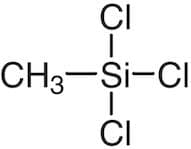
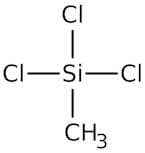
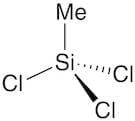
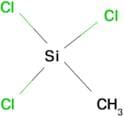
:Methyltrichlorosilane
- A 154
- A 154 (silane)
- Ka 13
- LS 40 (silane)
- Ls 40
- Methylsilicon trichloride
- Methylsilyl trichloride
- Nsc 77069
- Silane, Methyltrichloro
- Silane, trichloromethyl-
- Trichlor(methyl)silan
- Trichloro(methyl)silane
- Trichloromethylsilane
- Trichloromethylsilicon
- Tricloro(Metil)Silano
- See more synonyms
Trichloro(methyl)silane
CAS:Formula:CH3Cl3SiPurity:>98.0%(GC)(T)Color and Shape:Colorless to Almost colorless clear liquidMolecular weight:149.47Methyltrichlorosilane, 97%
CAS:Methyltrichlorosilane is used in production of methyl silicone resins, its vapor reacts with water on surfaces to give a thin layer of methylpolysiloxane which make it a water-repellent film. A combination of methyltrichlorosilane and sodium iodide can be used to cleave carbon-oxygen bonds such as mFormula:CH3Cl3SiPurity:97%Color and Shape:Clear colorless, LiquidMolecular weight:149.47Trichloromethylsilane, min. 97%
CAS:Trichloromethylsilane, min. 97%
Formula:CH3SiCl3Purity:min. 97%Color and Shape:colorless liq.Molecular weight:149.50METHYLTRICHLOROSILANE, 99% 5-GAL DRUM
CAS:Alkyl Silane - Conventional Surface Bonding
Aliphatic, fluorinated aliphatic or substituted aromatic hydrocarbon substituents are the hydrophobic entities which enable silanes to induce surface hydrophobicity. The organic substitution of the silane must be non-polar. The hydrophobic effect of the organic substitution can be related to the free energy of transfer of hydrocarbon molecules from an aqueous phase to a homogeneous hydrocarbon phase. A successful hydrophobic coating must eliminate or mitigate hydrogen bonding and shield polar surfaces from interaction with water by creating a non-polar interphase. Although silane and silicone derived coatings are in general the most hydrophobic, they maintain a high degree of permeability to water vapor. This allows coatings to breathe and reduce deterioration at the coating interface associated with entrapped water. Since ions are not transported through non-polar silane and silicone coatings, they offer protection to composite structures ranging from pigmented coatings to rebar reinforced concrete. A selection guide for hydrophobic silanes can be found on pages 22-31 of the Hydrophobicity, Hydrophilicity and Silane Surface Modification brochure.
Methyltrichlorosilane; Trichloromethylsilane; Trichlorosilylmethane
Viscosity: 0.46 cStΔHvap: 31.0 kJ/molSurface tension: 20.3 mN/mIonization potential: 11.36 eVSpecific heat: 0.92 J/g/°Vapor pressure, 13.5 °C: 100 mmCritical temperature: 243 °CCritical pressure: 39 atmCoefficient of thermal expansion: 1.3 x 10⁻³Fundamental builing-block for silicone resinsForms silicon carbide by pyrolysisIn a synergistic fashion with boron trifluoride etherate catalyzes the crossed imino aldehyde pinacol couplingIn combination with H2 forms SiC by CVDStandard grade available, SIM6520.0Formula:CH3Cl3SiPurity:99%Color and Shape:Straw LiquidMolecular weight:149.48METHYLTRICHLOROSILANE, 98% CYLINDER
CAS:Alkyl Silane - Conventional Surface Bonding
Aliphatic, fluorinated aliphatic or substituted aromatic hydrocarbon substituents are the hydrophobic entities which enable silanes to induce surface hydrophobicity. The organic substitution of the silane must be non-polar. The hydrophobic effect of the organic substitution can be related to the free energy of transfer of hydrocarbon molecules from an aqueous phase to a homogeneous hydrocarbon phase. A successful hydrophobic coating must eliminate or mitigate hydrogen bonding and shield polar surfaces from interaction with water by creating a non-polar interphase. Although silane and silicone derived coatings are in general the most hydrophobic, they maintain a high degree of permeability to water vapor. This allows coatings to breathe and reduce deterioration at the coating interface associated with entrapped water. Since ions are not transported through non-polar silane and silicone coatings, they offer protection to composite structures ranging from pigmented coatings to rebar reinforced concrete. A selection guide for hydrophobic silanes can be found on pages 22-31 of the Hydrophobicity, Hydrophilicity and Silane Surface Modification brochure.
Methyltrichlorosilane; Trichloromethylsilane; Trichlorosilylmethane
Viscosity: 0.46 cStΔHvap: 31.0 kJ/molSurface tension: 20.3 mN/mIonization potential: 11.36 eVSpecific heat: 0.92 J/g/°Vapor pressure, 13.5 °C: 100 mmCritical temperature: 243 °CCritical pressure: 39 atmCoefficient of thermal expansion: 1.3 x 10⁻³Fundamental builing-block for silicone resinsForms silicon carbide by pyrolysisIn a synergistic fashion with boron trifluoride etherate catalyzes the crossed imino aldehyde pinacol couplingHigher purity grade available, SIM6520.1Formula:CH3Cl3SiPurity:98%Color and Shape:Straw LiquidMolecular weight:149.48