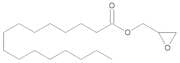
CAS 7501-44-2
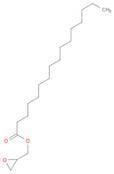
:oxiran-2-ylmethyl hexadecanoate
Description:
Oxiran-2-ylmethyl hexadecanoate, also known as glycidyl hexanoate, is an organic compound characterized by its ester functional group and an epoxide ring. This compound features a hexadecanoate (palmitate) moiety, which contributes to its hydrophobic properties, making it soluble in organic solvents but less so in water. The presence of the epoxide group imparts reactivity, allowing it to participate in various chemical reactions, such as ring-opening polymerization and cross-linking, which are valuable in polymer chemistry and materials science. Oxiran-2-ylmethyl hexadecanoate is often utilized in the production of specialty chemicals, coatings, and adhesives due to its ability to enhance mechanical properties and chemical resistance. Additionally, its structure suggests potential applications in the food and cosmetic industries, where it may serve as an emulsifier or stabilizer. Safety data indicates that, like many chemical substances, it should be handled with care, as it may pose health risks upon exposure. Overall, its unique chemical structure and properties make it a versatile compound in various industrial applications.
Formula:C19H36O3
InChI:InChI=1/C19H36O3/c1-2-3-4-5-6-7-8-9-10-11-12-13-14-15-19(20)22-17-18-16-21-18/h18H,2-17H2,1H3
SMILES:CCCCCCCCCCCCCCCC(=O)OCC1CO1
Sort by
Purity (%)
0
100
|
0
|
50
|
90
|
95
|
100
Found 10 products.
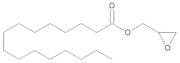
Palmitic acid-glycidyl ester 100 µg/mL in Acetonitrile
CAS:Formula:C19H36O3Color and Shape:Single SolutionMolecular weight:312.49Glycidyl Palmitate
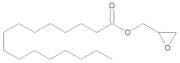
CAS:Applications Glycidyl Palmitate is used for preparation of lysophosphatidic acids which inhibit apoptosis.
References Mills, G.B., et al.: Nat. Rev. Cancer., 3, 582 (2003), Zhang, C., et al.: J. Exp. Med., 199, 763 (2004), Lee, C.W., J. Biol. Chem., 281 (2006),Formula:C19H36O3Color and Shape:White To Off-WhiteMolecular weight:312.49Glycidyl Palmitate-13C16
CAS:Applications Labelled Glycidyl Palmitate (G615950). Used for preparation of lysophosphatidic acids which inhibit apoptosis.
References Mills, G.B., et al.: Nat. Rev. Cancer., 3, 582 (2003), Zhang, C., et al.: J. Exp. Med., 199, 763 (2004), Lee, C.W., J. Biol. Chem., 281 (2006),Formula:C16C3H36O3Color and Shape:NeatMolecular weight:312.49Glycidyl Palmitate (1 mg/mL in Acetonitrile)
CAS:Controlled ProductFormula:C19H36O3Color and Shape:Single SolutionMolecular weight:312.49Glycidyl palmitate
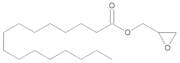
CAS:Glycidyl palmitate is a synthetic fatty acid ester that has reactive hydroxyl groups. It is used in the production of polylactic acid, a biodegradable polymer. Glycidyl palmitate can be prepared by reacting a fatty acid with glycerol and an epichlorohydrin. The elimination rate of glycidyl palmitate from the body has been shown to be activated by surface methodology such as chemical ionization mass spectrometry. Glycidyl palmitate can also be analyzed using gas chromatography with flame ionization detection (GC-FID) or gas chromatography-mass spectrometry (GC-MS). A sample preparation technique for glycidyl palmitate is to dissolve it in sodium salts and use filtration as the final step before analysis. The most common fatty acids present in glycidyl palmitate are oleic acid and linoleic acid.Formula:C19H36O3Purity:Min. 95%Molecular weight:312.49 g/mol