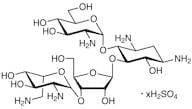
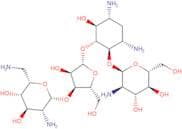
CAS 7542-37-2
:Paromomycin
- (1R,2R,3S,4R,6S)-4,6-Diamino-2-{[3-O-(2,6-diamino-2,6-dideoxy-beta-L-idopyranosyl)-beta-D-ribofuranosyl]oxy}-3-hydroxycyclohexyl 2-amino-2-deoxy-alpha-D-glucopyranoside
- 231-423-0
- <span class="text-smallcaps">D</smallcap>-Streptamine, O-2,6-diamino-2,6-dideoxy-β-<smallcap>L</smallcap>-idopyranosyl-(1→3)-O-β-<smallcap>D</smallcap>-ribofuranosyl-(1→5)-O-[2-amino-2-deoxy-α-<smallcap>D</span>-glucopyranosyl-(1→4)]-2-deoxy-
- <span class="text-smallcaps">D</smallcap>-Streptamine, O-2-amino-2-deoxy-α-<smallcap>D</smallcap>-glucopyranosyl-(1→4)-O-[O-2,6-diamino-2,6-dideoxy-β-<smallcap>L</smallcap>-idopyranosyl-(1→3)-β-<smallcap>D</span>-ribofuranosyl-(1→5)]-2-deoxy-
- Aminosidin
- Aminosidine
- Aminosidine I
- Amminosidin
- Antibiotic 2230D
- Antibiotic 503-3
- Antibiotic SF 767B
- Catenulin
- Crestomycin
- D-Streptamine, O-2,6-diamino-2,6-dideoxy-β-L-idopyranosyl-(1→3)-O-β-D-ribofuranosyl-(1→5)-O-[2-amino-2-deoxy-α-D-glucopyranosyl-(1→4)]-2-deoxy-
- D-Streptamine, O-2-amino-2-deoxy-α-D-glucopyranosyl-(1→4)-O-[O-2,6-diamino-2,6-dideoxy-β-L-idopyranosyl-(1→3)-β-D-ribofuranosyl-(1→5)]-2-deoxy-
- Gabbromicina
- Gabbromycin
- Gabromycin
- Humycin
- Hydroxymycin
- Monomycin A
- Neomycin E
- O-2,6-Diamino-2,6-dideoxy-β-<span class="text-smallcaps">L</smallcap>-idopyranosyl-(1→3)-O-β-<smallcap>D</smallcap>-ribofuranosyl-(1→5)-O-[2-amino-2-deoxy-α-<smallcap>D</smallcap>-glucopyranosyl-(1→4)]-2-deoxy-<smallcap>D</span>-streptamine
- Paromomicina
- Paromomycin I
- Paromomycine
- Paucimycin
- Quintomycin C
- R 400
- Streptamine, O-2,6-diamino-2,6-dideoxy-β-<span class="text-smallcaps">L</smallcap>-idopyranosyl-(1→3)-O-β-<smallcap>D</smallcap>-ribofuranosyl-(1→5)-O-[2-amino-2-deoxy-α-<smallcap>D</span>-glucopyranosyl-(1→4)]-2-deoxy-
- Streptamine, O-2,6-diamino-2,6-dideoxy-β-L-idopyranosyl-(1→3)-O-β-D-ribofuranosyl-(1→5)-O-[2-amino-2-deoxy-α-D-glucopyranosyl-(1→4)]-2-deoxy-
- Zygomycin A1
- Zygomycin A<sub>1</sub>
- See more synonyms
Paromomycin Sulfate
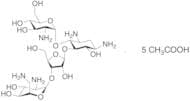
CAS:Formula:C23H45N5O14·xH2SO4Purity:>92.0%(HPLC)Color and Shape:White to Almost white powder to crystalParomomycin Deuterated Acetic Acid Salt
CAS:Controlled ProductApplications Paromomycin Deuterated Acetic Acid Salt is the isotope labelled analog of Paromomycin Sulfate. Paromomycin Sulfate is an aminogycoside antibiotic designed to fight intestinal infections such as cryptosporidiosis, amoebiasis, and leishmaniasis. Its antiprotozoal activity makes it an effecive histomonostatic feed additive in turkey poults experimentally infected with Histomonas meleagridis.
References Rehg, J.E. et al.: J. Infect. Dis., 170, 934 (1994); Fong, D. et al.: Am. J. Trop. Med. Hyg., 51, 758 (1994); Hafez, H.M. et al.: Arch. Anim. Nut., 64, 77 (2010);Formula:C23H45N5O14•5(CH3COOH)forundeuteratedColor and Shape:NeatMolecular weight:615.63Aminosidine
CAS:Aminosidine is a nucleoside analogue that inhibits the HIV-1 reverse transcriptase and the integrase, which are enzymes involved in viral DNA synthesis. Aminosidine is active against Leishmania spp., but not against bacteria. Aminosidine has been shown to be effective in experimental models of human bowel disease and in patients with inflammatory bowel disease. It was also found to be active against wild-type strains of human immunodeficiency virus type 1, but not resistant mutants. The mechanism of action is the inhibition of cellular mitochondrial membrane potential.
Purity:Min. 95%