CAS 7547-97-9
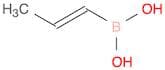
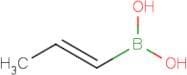
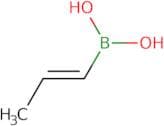
:(1E)-prop-1-en-1-ylboronic acid
Description:
(1E)-prop-1-en-1-ylboronic acid, also known as allylboronic acid, is an organoboron compound characterized by the presence of a boronic acid functional group attached to an allyl group. This compound typically appears as a colorless to pale yellow liquid or solid, depending on its form and purity. It is soluble in water and organic solvents, making it versatile for various chemical reactions. The boronic acid moiety allows for participation in reactions such as Suzuki coupling, which is valuable in organic synthesis for forming carbon-carbon bonds. Additionally, the presence of the double bond in the allyl group provides reactivity, enabling further transformations. (1E)-prop-1-en-1-ylboronic acid is often used in medicinal chemistry and materials science due to its ability to form stable complexes with diols and its utility in the synthesis of complex organic molecules. Safety precautions should be taken when handling this compound, as boronic acids can be irritants and may pose environmental hazards.
Formula:C3H7BO2
InChI:InChI=1/C3H7BO2/c1-2-3-4(5)6/h2-3,5-6H,1H3/b3-2+
Sort by
Purity (%)
0
100
|
0
|
50
|
90
|
95
|
100
Found 4 products.
trans-1-Propen-1-yl-boronic acid
CAS:Formula:C3H7BO2Purity:95%Color and Shape:SolidMolecular weight:85.8975Ref: IN-DA0032DC
10gTo inquire25gTo inquire50gTo inquire100gTo inquire250gTo inquire100mg50.00€250mg67.00€1g166.00€5g613.00€trans-1-Propen-1-yl-boronic acid
CAS:trans-1-Propen-1-yl-boronic acidPurity:98%Molecular weight:85.90g/moltrans-1-Propen-1-yl-boronic acid
CAS:Trans-1-propenylboronic acid is a boronic acid that can be used to synthesize chiral compounds. It is a product of the Sharpless asymmetric dihydroxylation reaction and has been shown to inhibit the activity of aldehyde oxidase. Trans-1-propenylboronic acid is reusable, which makes it an economical alternative to other boronic acids. The enantiomer of trans-1-propenylboronic acid can be obtained by the Suzuki coupling reaction with a variety of different electrophiles. This product also forms hydrogen bonds with the substrate and has shown anti-inflammatory effects in mice. Trans-1-propenylboronic acid can also undergo oxidation, reduction, or cyclization reactions and can form monosubstituted alicyclic products.Formula:C3H7BO2Purity:Min. 95%Color and Shape:SolidMolecular weight:85.9 g/mol