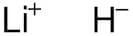
CAS 7580-67-8
:Lithium hydride
Description:
Lithium hydride (LiH) is an inorganic compound characterized by its formation of a binary hydride of lithium. It appears as a white or grayish solid and is known for its ionic structure, where lithium ions (Li⁺) and hydride ions (H⁻) are held together by strong ionic bonds. Lithium hydride is highly reactive, particularly with water, producing lithium hydroxide and hydrogen gas, which can be explosive in certain conditions. It has a high melting point and is stable under normal conditions, but it can decompose at elevated temperatures. This compound is utilized in various applications, including as a reducing agent in organic synthesis, in the production of lithium metal, and as a hydrogen storage material due to its ability to release hydrogen upon heating. Additionally, lithium hydride is used in nuclear fusion research and as a component in certain types of batteries. Safety precautions are necessary when handling LiH, as it can react violently with moisture and acids.
Formula:HLi
InChI:InChI=1S/Li.H
InChI key:InChIKey=SIAPCJWMELPYOE-UHFFFAOYSA-N
SMILES:[LiH]
Synonyms:- Hidruro De Litio
- Hydrure de lithium
- Lithium Hydride
- Lithium monohydride
- Lithiumhydrid
- Lithium hydride (LiH)
Sort by
Purity (%)
0
100
|
0
|
50
|
90
|
95
|
100
Found 2 products.
Lithium hydride, 99.4% (metals basis)
CAS:Lithium hydride is used as a precursor in the production of a variety of reagents in the synthesis, especially silane by reacting with silicon tetrachloride through Sundermeyer process and lithium aluminum hydride and lithium borohydride. It finds application in nuclear reactors as a shielding materFormula:HLiPurity:99.4%Molecular weight:7.95