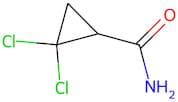
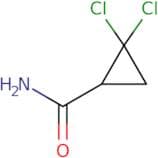
CAS 75885-60-8
:2,2-Dichlorocyclopropanecarboxamide
Description:
2,2-Dichlorocyclopropanecarboxamide is a chemical compound characterized by its unique cyclopropane structure, which features two chlorine atoms attached to the second carbon of the cyclopropane ring and an amide functional group. This compound typically appears as a colorless to pale yellow solid or liquid, depending on its specific form and purity. It is known for its potential applications in agricultural chemistry, particularly as a herbicide or pesticide, due to its ability to interfere with plant growth processes. The presence of chlorine atoms enhances its reactivity and stability, making it effective in various chemical reactions. Additionally, the amide group contributes to its solubility in polar solvents, which can influence its bioavailability and environmental behavior. Safety data sheets indicate that it should be handled with care, as it may pose health risks if ingested or inhaled. Overall, 2,2-Dichlorocyclopropanecarboxamide is a compound of interest in both industrial and research settings, warranting further investigation into its properties and applications.
Formula:C4H5Cl2NO
InChI:InChI=1S/C4H5Cl2NO/c5-4(6)1-2(4)3(7)8/h2H,1H2,(H2,7,8)
InChI key:InChIKey=POUMCBWMYUEVKF-UHFFFAOYSA-N
SMILES:C(N)(=O)C1C(Cl)(Cl)C1
Synonyms:- 2,2-Dichlorocyclopropane-1-carboxamide
- Cyclopropanecarboxamide, 2,2-Dichloro-
- 2,2-Dichlorocyclopropanecarboxamide
Sort by
Purity (%)
0
100
|
0
|
50
|
90
|
95
|
100
Found 2 products.
2,2-Dichlorocyclopropane-1-carboxamide
CAS:2,2-Dichlorocyclopropane-1-carboxamidePurity:≥95%Color and Shape:PowderMolecular weight:153.99g/mol2,2-Dichlorocyclopropanecarboxamide
CAS:2,2-Dichlorocyclopropanecarboxamide is a horticultural fungicide that is used to control plant diseases caused by fungi. It inhibits growth of the fungus by preventing the synthesis of proteins vital for cell division. 2,2-Dichlorocyclopropanecarboxamide also reacts with chlorine and other halogens in the environment to produce toxic compounds. This chemical may pose an environmental risk due to its high reactivity with other chemicals, such as hydrochloric acid or chlorides.Formula:C4H5Cl2NOPurity:Min. 95%Molecular weight:153.99 g/mol