CAS 75996-29-1
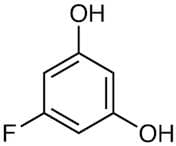
:5-fluorobenzene-1,3-diol
Description:
5-Fluorobenzene-1,3-diol, also known by its CAS number 75996-29-1, is an aromatic compound characterized by the presence of a fluorine atom and two hydroxyl (-OH) groups attached to a benzene ring. The fluorine substituent is located at the 5-position, while the hydroxyl groups are positioned at the 1 and 3 positions, making it a dihydroxy derivative of fluorobenzene. This compound exhibits properties typical of phenolic compounds, including potential antioxidant activity due to the presence of hydroxyl groups. It is likely to be soluble in polar solvents due to its ability to form hydrogen bonds, while its aromatic nature may impart some degree of hydrophobicity. The presence of the fluorine atom can influence the compound's reactivity and biological activity, potentially enhancing its lipophilicity and altering its interaction with biological targets. 5-Fluorobenzene-1,3-diol may have applications in pharmaceuticals, agrochemicals, or as an intermediate in organic synthesis, although specific applications would depend on further research and development.
Formula:C6H5FO2
InChI:InChI=1/C6H5FO2/c7-4-1-5(8)3-6(9)2-4/h1-3,8-9H
SMILES:c1c(cc(cc1O)O)F
Synonyms:- 1,3-Benzenediol, 5-fluoro-
Sort by
Purity (%)
0
100
|
0
|
50
|
90
|
95
|
100
Found 5 products.
5-Fluororesorcinol
CAS:Formula:C6H5FO2Purity:>98.0%(GC)(T)Color and Shape:White to Light yellow to Light orange powder to crystalMolecular weight:128.105-Fluororesorcinol
CAS:5-Fluororesorcinol is a fluorine-containing analog of resorcinol. It is used as a topical medication for the treatment of acne, psoriasis, and other skin disorders. 5-Fluororesorcinol has been shown to inhibit the production of tyrosinase, an enzyme that catalyzes the oxidation of phenols to quinones. This process is involved in the formation of melanin and plays a role in inflammation and cell proliferation. 5-Fluororesorcinol also binds to cannabinoid receptors (CB1 and CB2) with high affinity. The molecular model for 5-fluoro resorcinol shows hydrogen bonding interactions with the hydroxyl group and fluorine atom. It also exhibits ferroelectric behavior due to its nonlinear dipole moment. The presence of two isomers (5R or 6S) may be due to steric hindrance from one or more methyl groups in the orthoFormula:C6H5FO2Purity:Min. 95%Molecular weight:128.1 g/mol