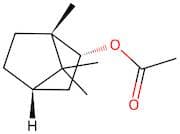
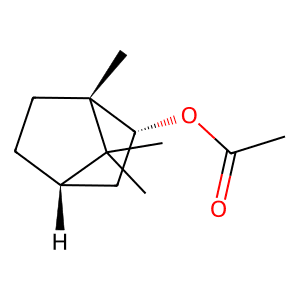
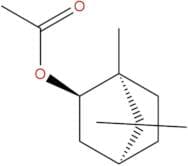
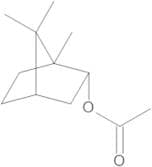
CAS 76-49-3
:(±)-Bornyl acetate
Description:
(±)-Bornyl acetate is an organic compound classified as an ester, specifically derived from bornyl alcohol and acetic acid. It is a colorless to pale yellow liquid with a characteristic pleasant, pine-like aroma, making it popular in the fragrance and flavor industries. The compound has a relatively low boiling point and is soluble in organic solvents, but only slightly soluble in water. Its molecular formula is C12H20O2, and it features a bicyclic structure typical of terpenes, which contributes to its distinctive scent. (±)-Bornyl acetate is often used in perfumes, cosmetics, and food flavorings due to its aromatic properties. Additionally, it exhibits some antimicrobial and insect-repellent activities, making it of interest in various applications beyond fragrance. As a chiral compound, it exists in two enantiomeric forms, but the racemic mixture is commonly referred to as (±)-Bornyl acetate. Safety data indicates that it should be handled with care, as it can cause irritation upon contact with skin or eyes.
Formula:C12H20O2
InChI:InChI=1/C12H20O2/c1-8(13)14-10-7-9-5-6-12(10,4)11(9,2)3/h9-10H,5-7H2,1-4H3/t9-,10+,12+/s2
InChI key:InChIKey=KGEKLUUHTZCSIP-QJUVKGSQNA-N
SMILES:C[C@@]12[C@H](OC(C)=O)C[C@@](C1(C)C)(CC2)[H]
Synonyms:- 1,7,7-Trimethylbicyclo(2.2.1)heptan-2-ol acetate
- 1,7,7-Trimethylbicyclo(2.2.1)heptan-2-yl acetate, endo-
- 2-Camphanol acetate
- 2-Camphanyl acetate
- Acetate de endo-1,7,7-trimethylbicyclo[2.2.1]hept-2-yle
- Acetate, 1,7,7-Trimethyl-Bicyclo(2.2.1)Hept-2-Yl, Endo-
- Acetato De Endo-1,7,7-Trimetilbiciclo[2.2.1]Hept-2-Ilo
- Ai3-00665
- Bicyclo(2.2.1)heptan-2-ol, 1,7,7-trimethyl-, 2-acetate, (1R,2S,4R)-rel-
- Bicyclo(2.2.1)heptan-2-ol, 1,7,7-trimethyl-, acetate, (1R,2S,4R)-rel-
- Bicyclo(2.2.1)heptan-2-ol, 1,7,7-trimethyl-, acetate, endo-
- Borneol, acetate
- Borneol, acetate (8CI)
- Borneyl acetate
- Bornyl acetic ester
- Bornyl acetic ether
- Bornyl ethanoate
- Endo-1,7,7-trimethylbicyclo[2.2.1]hept-2-yl aceatate
- FEMA No. 2159
- Nsc 407158
- dl-Bornyl acetate
- endo-1,7,7-Trimethylbicyclo(2.2.1)hept-2-yl acetate
- endo-1,7,7-Trimethylbicyclo[2.2.1]hept-2-ylacetat
- endo-2-Camphanyl ethanoate
- endo-Bornyl acetate
- See more synonyms
Sort by
Purity (%)
0
100
|
0
|
50
|
90
|
95
|
100
Found 10 products.
Bicyclo[2.2.1]heptan-2-ol,1,7,7-trimethyl-, 2-acetate, (1R,2S,4R)-rel-
CAS:Formula:C12H20O2Purity:97%Molecular weight:196.2860Bornyl acetate
CAS:Bornyl acetate (Isobornyl acetate) has an anti-inflammatory effect. It is the volatile ingredient in some Chinese traditional herbs and numerous conifer oils.Formula:C12H20O2Purity:99.19%Color and Shape:LiquidMolecular weight:196.29Bornyl acetate
CAS:Formula:C12H20O2Purity:≥ 90.0%Color and Shape:Clear, colourless to pale yellow liquidMolecular weight:196.29Bornyl Acetate (Mixture of Diastereomers)
CAS:Applications Bornyl Acetate (Mixture of Diastereomers) is a monoterpene ester, and also the main, natural constituent of valerian root oil. Bornyl acetate also has analgesic and anti-inflammatory properties.
References Buchbauer, G., et al.: Die Pharm., 47, 620 (1992); Oh, H., et al.: Appl. Micro., 15, 777 (1967); Wu, X., et al.: J. Chinese Med. Mat., 27, 438 (2004)Formula:C12H20O2Color and Shape:NeatMolecular weight:196.29(+/-)-Bornyl acetate
CAS:(-)Bornyl acetate is a natural product that has been shown to have antimicrobial properties. It is extracted from plants such as the Boronia and has been shown to inhibit the growth of bacteria. (-)Bornyl acetate interacts with hydroxyl groups on proteins, inhibiting their function. This interaction leads to the production of reactive oxygen species, which causes cellular damage and death. Bornyl acetate also can interact with other sites on proteins, including the nitro group, which may lead to reduced nitric oxide production and decreased inflammatory response. The compound class of (-)bornyl acetate includes alkanoic acids and fatty acids. Molecular docking analysis has identified a number of possible binding sites for this molecule in protein structures. -Bornyl acetate is not active against viruses or fungi.br>br> Bornyl acetate has been shown to be an anti-inflammatory agent that inhibits prostaglandin synthesis and exhibits anti-infective properties.br>brFormula:C12H20O2Purity:Min. 95%Color and Shape:Clear LiquidMolecular weight:196.29 g/mol
![Bicyclo[2.2.1]heptan-2-ol,1,7,7-trimethyl-, 2-acetate, (1R,2S,4R)-rel-](/_next/image/?url=https%3A%2Fstatic.cymitquimica.com%2Fproducts%2FIN%2Fthumb%2FDA0038GL.jpg&w=3840&q=75)