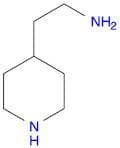
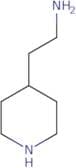
CAS 76025-62-2
:4-Piperidineethanamine
Description:
4-Piperidineethanamine, also known as N-(2-aminoethyl)piperidine, is an organic compound characterized by its piperidine ring structure with an ethylamine side chain. It is a colorless to pale yellow liquid at room temperature and is soluble in water and various organic solvents, which makes it versatile in chemical applications. The compound features both amine and piperidine functional groups, contributing to its basicity and reactivity. It is often used as an intermediate in the synthesis of pharmaceuticals, agrochemicals, and other organic compounds. Due to the presence of the piperidine ring, it can exhibit various biological activities, making it of interest in medicinal chemistry. Safety data indicates that it should be handled with care, as it may cause irritation to the skin, eyes, and respiratory system. Proper storage in a cool, dry place away from incompatible substances is recommended to maintain its stability and integrity.
Formula:C7H16N2
Synonyms:- Piperidine,4-(2-aminoethyl)- (7CI)
- 4-(2-Aminoethyl)piperidine
- 4-(Aminoethyl)piperidine
Sort by
Purity (%)
0
100
|
0
|
50
|
90
|
95
|
100
Found 2 products.
2-(Piperidin-4-yl)ethan-1-amine
CAS:2-(Piperidin-4-yl)ethan-1-amine is a nonsteroidal anti-inflammatory drug (NSAID) that inhibits the enzyme pancreatic lipase. This inhibition of lipases leads to the decrease in triglycerides and phospholipids in the blood, which prevents inflammation. 2-(Piperidin-4-yl)ethan-1-amine has been shown to have antibacterial and antifungal properties. It has been used for the treatment of infections caused by Mycobacteria sp., including Mycobacterium tuberculosis, M. avium complex, and M. kansasii. It also has been used for the treatment of orlistat induced side effects such as steatorrhea and diarrhea. The use of this drug is limited because it can cause liver toxicity or gastrointestinal ulceration at high doses.
Formula:C7H16N2Purity:Min. 95%Molecular weight:128.22 g/molRef: 3D-BDA02562
Discontinued product