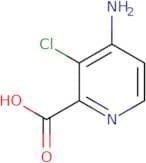
CAS 76165-18-9
:4-amino-3-chloropyridine-2-carboxylic acid
Description:
4-Amino-3-chloropyridine-2-carboxylic acid is an organic compound characterized by its pyridine ring, which is a six-membered aromatic heterocycle containing one nitrogen atom. This compound features an amino group (-NH2) and a carboxylic acid group (-COOH) attached to the pyridine ring, along with a chlorine atom at the 3-position. The presence of these functional groups contributes to its polar nature, making it soluble in polar solvents like water. It is often used in pharmaceutical research and synthesis due to its potential biological activity. The compound's structure allows for various chemical reactions, including nucleophilic substitutions and coupling reactions, which are valuable in organic synthesis. Additionally, its unique properties may lend it applications in agrochemicals or as an intermediate in the production of other chemical compounds. Safety data should be consulted for handling, as with any chemical substance, to ensure proper precautions are taken.
Formula:C6H5ClN2O2
InChI:InChI=1/C6H5ClN2O2/c7-4-3(8)1-2-9-5(4)6(10)11/h1-2H,(H2,8,9)(H,10,11)
SMILES:c1cnc(c(c1N)Cl)C(=O)O
Synonyms:- 2-Pyridinecarboxylic acid, 4-amino-3-chloro-
- 4-Amino-3-chloro-2-pyridinecarboxylic acid
- 4-Amino-3-chloro-alpha-picolinic acid
- 4-Amino-3-chloropicolinic acid
- T6Nj Bvq Cg Dz [Wln]
Sort by
Purity (%)
0
100
|
0
|
50
|
90
|
95
|
100
Found 1 products.
4-Amino-3-chloropyridine-2-carboxylic acid
CAS:4-Amino-3-chloropyridine-2-carboxylic acid (4ACPC) is an herbicide that has been used to control weeds in rice fields, sugar cane, and other crops. 4ACPC inhibits the growth of plants by inhibiting photosynthesis. It binds to the electron transport system in chloroplasts and reduces the amount of ATP available for use. This leads to a decrease in chlorophyll production and photosynthetic activity, which ultimately causes plant death. 4ACPC also binds to DNA and has been shown to inhibit transcription in calf thymus cells.Formula:C6H5ClN2O2Purity:Min. 95%Molecular weight:172.57 g/mol