CAS 7617-76-7
:3-phenoxypropan-1-amine
Description:
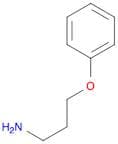
3-Phenoxypropan-1-amine, with the CAS number 7617-76-7, is an organic compound characterized by its amine functional group and a phenoxy substituent. It features a three-carbon propyl chain attached to an amine group at one end and a phenoxy group at the other. This compound is typically a colorless to pale yellow liquid or solid, depending on its purity and specific conditions. It is soluble in organic solvents and may exhibit limited solubility in water due to the hydrophobic nature of the phenoxy group. 3-Phenoxypropan-1-amine can participate in various chemical reactions typical of amines, such as nucleophilic substitutions and acylation. Its structure allows it to potentially act as a building block in the synthesis of more complex organic molecules, including pharmaceuticals and agrochemicals. Safety data indicates that, like many amines, it should be handled with care, as it may cause irritation to the skin and eyes. Proper safety protocols should be followed when working with this compound in laboratory or industrial settings.
Formula:C9H13NO
InChI:InChI=1/C9H13NO/c10-7-4-8-11-9-5-2-1-3-6-9/h1-3,5-6H,4,7-8,10H2
SMILES:c1ccc(cc1)OCCCN
Synonyms:- 1-Propanamine, 3-phenoxy-
- (3-Phenoxy)propylamine
- 3-Phenoxypropan-1-amine
Sort by
Purity (%)
0
100
|
0
|
50
|
90
|
95
|
100
Found 4 products.
1-Propanamine, 3-phenoxy-
CAS:Formula:C9H13NOPurity:95%Color and Shape:LiquidMolecular weight:151.2056(3-Phenoxy)propylamine
CAS:Phenoxypropylamine is an alkylthio-substituted phenethylamine with a hydroxy group that is used in the synthesis of nitro, quinoline derivatives. It binds to the 5-hydroxytryptamine 1A receptor and inhibits serotonin reuptake. Phenoxypropylamine also has pharmacokinetic properties and is a transport inhibitor. This drug can be hydrolyzed by hydrochloric acid to form phenol and propranolol. In addition, it has been shown that phenoxypropylamine has a magnetic resonance spectroscopy binding site on human brain tissue. Furthermore, this drug has been shown to have an anti-inflammatory effect by inhibiting malic acid production in rats.Formula:C9H13NOPurity:Min. 95%Molecular weight:151.21 g/mol