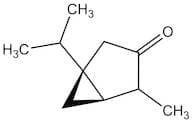
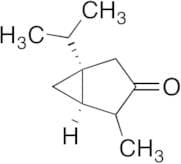
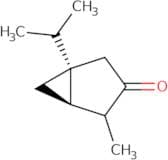
![(1S,5R)-4-methyl-1-(1-methylethyl)bicyclo[3.1.0]hexan-3-one](/_next/image/?url=https%3A%2Fstatic.cymitquimica.com%2Fcas-image%2Fthumb-webp%2F298590-1s-5r-4-methyl-1-1-methylethyl-bicyclo-3-1-0-hexan-3-one.webp&w=3840&q=75)
CAS 76231-76-0
:(1S,5R)-4-methyl-1-(1-methylethyl)bicyclo[3.1.0]hexan-3-one
Description:
The chemical substance known as (1S,5R)-4-methyl-1-(1-methylethyl)bicyclo[3.1.0]hexan-3-one, with the CAS number 76231-76-0, is a bicyclic ketone characterized by its unique structural framework. This compound features a bicyclo[3.1.0]hexane core, which consists of two fused rings, contributing to its rigidity and specific stereochemistry. The presence of a ketone functional group at the 3-position and a branched alkyl substituent at the 1-position enhances its reactivity and potential applications in organic synthesis. The stereochemical configuration, indicated by the (1S,5R) notation, suggests that the compound exhibits chirality, which may influence its biological activity and interactions. Generally, compounds of this type can be of interest in fields such as medicinal chemistry, fragrance formulation, and materials science due to their distinctive properties and potential utility in various chemical reactions. Further studies would be necessary to explore its specific applications and biological effects.
Formula:C10H16O
InChI:InChI=1/C10H16O/c1-6(2)10-4-8(10)7(3)9(11)5-10/h6-8H,4-5H2,1-3H3/t7?,8-,10+/m1/s1
Sort by
Purity (%)
0
100
|
0
|
50
|
90
|
95
|
100
Found 5 products.
Α,β-thujone
CAS:Alicyclic ketoneFormula:C10H16OPurity:≥ 98.0 % (GC)Color and Shape:LiquidMolecular weight:152.24α,β-Thujone (>90%)
CAS:Applications α,β-Thujone is a component of the essential oil of Pistacia vera L. It is also used as as a reactant in organic synthesis.
References Kalalinia, F., et al.: J. of Esse. Oil-Bearing Plants, 11(4), 376-383 (2008);Bunge, Alexander, et al.: Tetrahedron, 69(11), 2446-2450 (2013);Zhu, Shifa, et al.: Angewandte Chemie, I.E., 54(32), 9414-9418 (2015)Formula:C10H16OPurity:>90%Color and Shape:NeatMolecular weight:152.23alpha,beta-Thujone
CAS:Thujone is a natural organic compound that is found in many plants, including the herb wormwood. Thujone has been shown to have significant cytotoxicity and to increase the production of gamma-aminobutyric acid (GABA) in certain brain cells. The deuterium isotope effect was measured on two rat brain homogenates and showed a decrease in GABA levels after administration of thujone. This effect is thought to be due to the inhibition of soybean lipoxygenase by thujone, which leads to decreased oxygenation of lipids and subsequent oxidative stress. Thujone binds to the GABA receptor with high affinity, thereby blocking its activity and causing an increase in GABA levels.Formula:C10H16OPurity:Min. 95%Color and Shape:Clear LiquidMolecular weight:152.23 g/mol