CAS 76361-99-4
:3-Bromo-2-nitrophenol
Description:
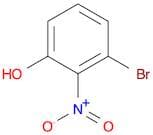
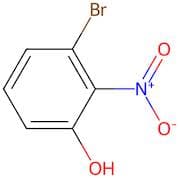
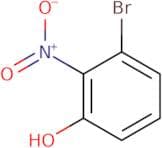
3-Bromo-2-nitrophenol is an organic compound characterized by the presence of both bromine and nitro functional groups attached to a phenolic ring. Its molecular structure features a bromine atom at the meta position and a nitro group at the ortho position relative to the hydroxyl (-OH) group. This compound typically appears as a solid and is known for its yellow to brown coloration. It is soluble in organic solvents but has limited solubility in water due to the hydrophobic nature of the aromatic ring. 3-Bromo-2-nitrophenol exhibits acidic properties, as the hydroxyl group can donate a proton, making it a weak acid. It is often used in organic synthesis and as an intermediate in the production of dyes, pharmaceuticals, and agrochemicals. Additionally, the presence of both bromine and nitro groups can enhance its reactivity, making it a valuable compound in various chemical reactions. Safety precautions should be taken when handling this substance, as it may pose health risks if inhaled or ingested.
Formula:C6H4BrNO3
InChI:InChI=1/C6H4BrNO3/c7-4-2-1-3-5(9)6(4)8(10)11/h1-3,9H
SMILES:c1cc(c(c(c1)O)N(=O)=O)Br
Synonyms:- Phenol, 3-Bromo-2-Nitro-
- 3-Bromo-2-nitrophenol
- 3-Bromo-2-nitrophenol96%
- 2-Nitro-3-bromophenol
- 2-Bromo-6-hydroxynitrobenzene
- 3-Bromo-2-nitrophenol 99%
Sort by
Purity (%)
0
100
|
0
|
50
|
90
|
95
|
100
Found 4 products.
3-Bromo-2-nitrophenol
CAS:3-Bromo-2-nitrophenolFormula:C6H4BrNO3Purity:96%Color and Shape: yellow crystalline solidMolecular weight:218.00g/mol3-Bromo-2-nitrophenol
CAS:3-Bromo-2-nitrophenol (3-BNP) is a brominating agent that can be used in the synthesis of a variety of compounds. It is prepared by the refluxing of 3-bromo-2-nitrobenzene with lithium chloride, followed by treatment with trifluoromethanesulfonic anhydride to yield 3-bromo-2-(trifluoromethyl)phenoxyacetic acid. The product can also be obtained from 2,4,6-trinitrophenol and NBS. 3-BNP has shown chemoselectivity for chlorides relative to iodides or fluorides. The yields are higher when it is used in coupling reactions and permutations with lithium or magnesium.Formula:C6H4BrNO3Purity:Min. 95%Molecular weight:218 g/mol