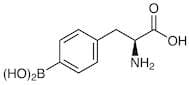
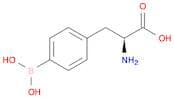
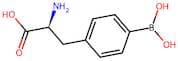
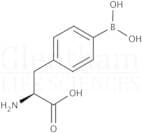
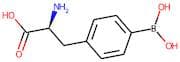
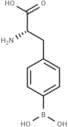
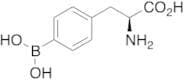
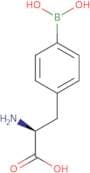
CAS 76410-58-7
:L-p-Boronophenylalanine
- 10B-Bpa
- 4-(Dihydroxyboranyl)Phenylalanine
- 4-(Dihydroxyboryl)-<span class="text-smallcaps">L</span>-phenylalanine
- 4-(dihydroxyboranyl)-L-phenylalanine
- 4-Borono-<span class="text-smallcaps">L</span>-phenylalanine
- 4-Boronophenylalanine
- 4-Dihydroxyborylphenylalanine
- <span class="text-smallcaps">L</span>-BPA
- <span class="text-smallcaps">L</span>-Phenylalanine, 4-borono-
- <span class="text-smallcaps">L</span>-p-Boronophenylalanine
- L-Phenylalanine, 4-borono-
- para-Borono-L-phenylalanine
- para-Boronophenylalanine
- 4-(Dihydroxyboryl)-L-phenylalanine
- 4-Borono-L-phenylalanine
- L-BPA
- L-p-Boronophenylalanine
- 4-BORONO-L-PHENYLALANINE B10 ENRICHED
- L-4-PHENYLALANINEBORONIC ACID
- (S)-(4-BORONIC ACID)-PHENYLALANINE
- 4-L-BPA
- 4-Dihydroxyboryl-L-phenylalanine, L-BPA
- L-PHE[B(OH)2]
- See more synonyms
4-Borono-L-phenylalanine (contains varying amounts of Anhydride)
CAS:Formula:C9H12BNO4Purity:>98.0%(T)(HPLC)Color and Shape:White to Light yellow powder to crystalMolecular weight:209.01(S)-2-Amino-3-(4-boronophenyl)propanoic acid
CAS:Formula:C9H12BNO4Purity:98%Color and Shape:SolidMolecular weight:209.0069L-4-(2-Amino-2-carboxyethyl)benzeneboronic acid
CAS:L-4-(2-Amino-2-carboxyethyl)benzeneboronic acidFormula:C9H12BNO4Purity:≥95%Color and Shape: white solidMolecular weight:209.01g/mol4-Borono-L-phenylalanine
CAS:4-Borono-L-phenylalanine: antitumor agent for melanoma, glioblastoma trials in boron neutron capture therapy.Formula:C9H12BNO4Purity:96.45%Color and Shape:SolidMolecular weight:209.014-Borono-L-phenylalanine
CAS:Controlled ProductApplications 4-Borono-L-phenylalanine is an unnatural derivative of L-Phenylalanine (P319415). a nonpolar, essential amino acid that naturally occurs in the human body and is also used to treat patients with depression. 4-Borono-L-phenylalanine is also being used as a mediator in sequential boron neutron capture therapy, a new method of treating oral cancer.
References Birkmayer, W., et al.: J. Neural Transm., 59, 81 (1984); Johnson, D.,et al.: Nat. Chem. Biol., 7, 779 (2011); Kankaanranta, L., et al.: Int. J. Radiat. Oncol., 80, 369 (2011); Molinari, A., et al.: Radiat. Res., 175, 463 (2011)Formula:C9H12BNO4Color and Shape:NeatMolecular weight:209.014-Borono-L-phenylalanine
CAS:4-Borono-L-phenylalanine is a boron-containing compound that has been used to study the biological effects of radiation. 4-Borono-L-phenylalanine is an analytical tool for measuring neutron scattering and other physical properties. It has also been used as a biochemical probe in studies of DNA duplexes. 4-Borono-L-phenylalanine is toxic to cells, inhibiting protein synthesis, and it can induce apoptosis in tumor cells. In experimental models, 4-borono-L phenylalanine can be administered orally or intravenously and has shown acute toxicity in animals at doses of up to 1000 mg/kg body weight.
Formula:C9H12BNO4Purity:Min. 95%Color and Shape:White PowderMolecular weight:209.01 g/molL-4-Phenylalanineboronic acid
CAS:Formula:C9H12BNO4Purity:98%Color and Shape:SolidMolecular weight:209.01