CAS 765-87-7
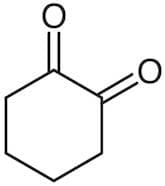
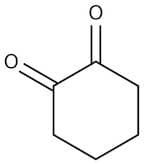
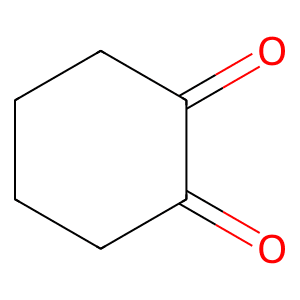
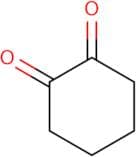
:1,2-Cyclohexanedione
- 1,2-Dioxocyclohexane
- Ai3-25042
- Brn 0507419
- Ccris 6296
- Cyclohexane-1,2-Dione
- NSC 627435
- Nsc 32950
- Cyclohexan-1,2-dione
- 1,2-Cyclohexanedione
- 4-07-00-01982 (Beilstein Handbook Reference)
1,2-Cyclohexanedione
CAS:Formula:C6H8O2Purity:>97.0%(GC)Color and Shape:White or Colorless to Light yellow to Light orange powder to lump to clear liquidMolecular weight:112.131,2-Cyclohexanedione, 98+%
CAS:1,2-Cyclohexanedione is utilized as a substrate to study enzyme cyclohexane-1,2-dione hydrolase, which is a new tool to degrade alicyclic compounds. It also acts as a specific reagent for arginine residues. This Thermo Scientific Chemicals brand product was originally part of the Alfa Aesar productFormula:C6H8O2Purity:98+%Color and Shape:Fused solid or clear liquid as melt, White to pale cream to pale yellowMolecular weight:112.131,2-Cyclohexanedione
CAS:1,2-Cyclohexanedione exhibits binding activity toward ketopantoyl-lactone reductase from Candida parapsilosisFormula:C6H8O2Purity:96.77%Color and Shape:Yellow SolidMolecular weight:112.13Cyclohexane-1,2-dione
CAS:Cyclohexane-1,2-dioneFormula:C6H8O2Purity:95%Color and Shape: colourless solidMolecular weight:112.12651g/molCyclohexane-1,2-dione
CAS:Cyclohexane-1,2-dione is a natural compound that can be found in kidney beans and other plants. It has been shown to inhibit the growth of tumor cells in vitro. Cyclohexane-1,2-dione binds to DNA polymerase, preventing replication and transcription. This reaction mechanism is similar to that of the rifamycins. Cyclohexane-1,2-dione has also been shown to bind enzymes such as nitrite ion reductase with high affinity and inhibit their activity. Cyclohexane-1,2-dione is chemically stable and does not react with metal ions or form stable complexes with biological molecules. The redox potentials for this molecule are -0.42 V (5/6) under aerobic conditions and -0.52 V (5/6) under anaerobic conditions.
Formula:C6H8O2Purity:Min. 96.5%Color and Shape:PowderMolecular weight:112.13 g/mol1,2-Cyclohexanedione (exists as tautomeric mixture)
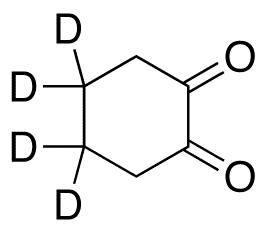
CAS:Formula:C6H8O2Purity:95%Color and Shape:Solid, Low Melting Solid or LumpsMolecular weight:112.1281,2-Cyclohexanedione-d4
CAS:Controlled ProductApplications 1,2-Cyclohexanedione-d4 is the isotope labelled analog of 1,2-Cyclohexanedione (C988085), a compound used as a substrate to study enzyme cyclohexane-1,2-dione hydrolase as a new tool to degrade alicyclic compounds.
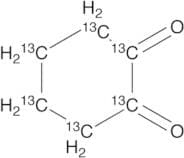
References Fraas, S., et al.: J. Molec. Cataly. B. Enzy., 61, 47 (2009); Steinbach, A., et al.: FEBS. J., 279, 1209 (2012);Formula:C6D4H4O2Color and Shape:NeatMolecular weight:116.1511,2-Cyclohexanedione-13C6
CAS:Controlled ProductApplications 1,2-Cyclohexanedione-13C6 is the isotope labelled analog of 1,2-Cyclohexanedione (C988085), a compound used as a substrate to study enzyme cyclohexane-1,2-dione hydrolase as a new tool to degrade alicyclic compounds.
References Fraas, S., et al.: J. Molec. Cataly. B. Enzy., 61, 47 (2009); Steinbach, A., et al.: FEBS. J., 279, 1209 (2012);Formula:C6H8O2Color and Shape:NeatMolecular weight:118.082